Most hedges don’t add value — they add a maintenance liability that shows up in the inspection report. Buyers don’t see a hedge. They see a job.
Here are the 33 that actually work.
33. Arborvitae (Thuja occidentalis)

Arborvitae is the default hedge of American suburbia, and that’s exactly why it’s ranked last.
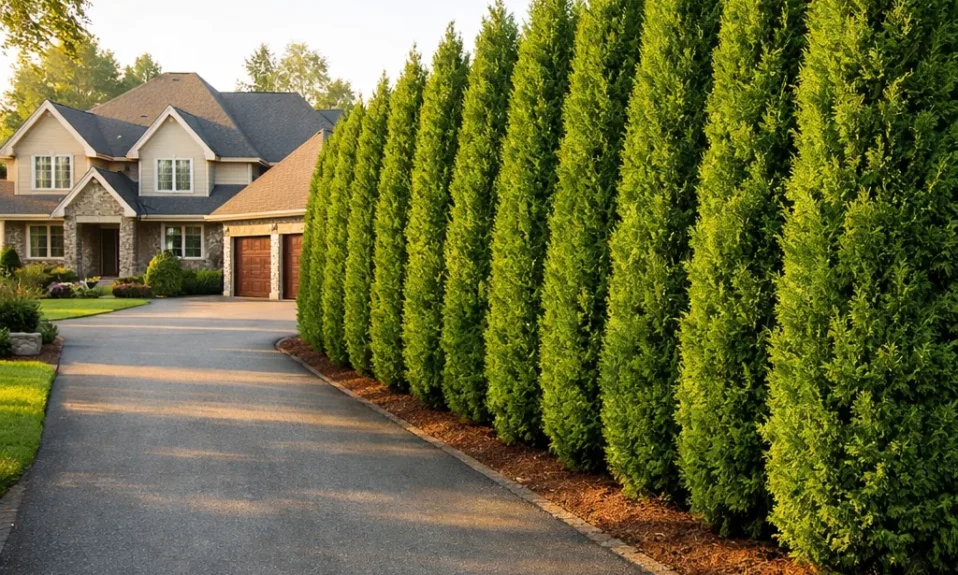
It works. It grows fast — up to 3 feet per year for Green Giant varieties — establishes for $25–$60 per plant, and gives you a genuine privacy screen within three to five years. Buyers recognize it immediately, which is the point.
But “recognizable” cuts both ways. A row of untrimmed arborvitae with brown patches from spider mites or bagworms sends one signal above all others: nobody has been paying attention here. In markets from Ohio to Virginia, I watched buyers mentally subtract $5,000–$12,000 from their offer price based on the condition of arborvitae alone.
Keep them immaculate or don’t bother planting them at all.
32. Skip Laurel (Prunus laurocerasus ‘Schipkaensis’)

Skip Laurel is the workhorse of the privacy hedge world, and it deserves credit for that.
It’s broadleaf evergreen, deer resistant in most regions, grows 24 inches per year once established, and costs $30–$80 per plant. The dark, glossy leaves photograph beautifully in listing photos — which matters more than most sellers realize.
The caveat is scale. Skip Laurel left untrimmed will grow to 10 feet wide and 18 feet tall. I’ve seen it devour walkways, swallow fences, and block windows the listing photos were trying to feature. A maintained Skip Laurel row is a genuine asset. An overgrown one triggers root intrusion concerns in buyers who know what they’re looking at.
Trim it twice a year and it will repay you in kind.
31. Green Giant Arborvitae (Thuja standishii × plicata)

Green Giant is a different animal from standard arborvitae — faster, taller, and more resistant to bagworms and spider mites that plague its smaller cousin.
It grows 3–5 feet per year when young, reaches 50–60 feet at maturity, and costs $40–$120 per plant at 4–5 feet height. For privacy screens backing large lots, it is genuinely unmatched in the mid-Atlantic and Southeast.
The problem is that same scale. A 15-foot Green Giant hedge on a quarter-acre lot doesn’t say “privacy.” It says “shade dispute waiting to happen.” Buyers with solar panels, vegetable gardens, or second-story windows facing the hedge will negotiate around it. Know your lot before you plant this one.
It signals permanence and intention — just make sure those align with your buyer pool.
30. Boxwood (Buxus sempervirens)

Boxwood is the prestige hedge — the one that shows up in every luxury listing photo and every Better Homes and Gardens spread.
Formally trimmed boxwood along a front walkway or flanking an entry signals money, taste, and care. A well-maintained boxwood hedge adds measurable curb appeal in markets where buyers expect manicured grounds. Expect to pay $25–$60 per plant for English boxwood and significantly more for established specimens.
Here is the problem I watched destroy listing after listing over the past decade: boxwood blight. Calonectria pseudonaviculata has swept through the Mid-Atlantic, Northeast, and parts of the Midwest, and a blighted boxwood row is one of the most alarming sights a buyer can encounter. Bare stems, brown defoliation, and the particular smell of fungal rot. In affected regions, buyers’ agents now routinely flag boxwood as a liability.
Plant only disease-resistant varieties like ‘SuffruticosaNewGen’ and ‘NewGen Independence’ if you’re in the Mid-Atlantic. Otherwise, this ranking could be several spots lower.
“The next five on this list are ones sellers plant with confidence — and buyers negotiate around more than you’d think.”
29. Privet (Ligustrum ovalifolium / Ligustrum vulgare)

Privet grows fast, forms dense screens, and is so cheap to establish ($10–$25 per plant) that generations of homeowners planted it without a second thought.
That affordability is now a liability signal. Privet is classified as invasive in at least 38 states. Buyers in the Southeast, Mid-Atlantic, and Pacific Northwest increasingly recognize it, and environmental-minded buyers — a growing demographic — will ask direct questions about it. A privet hedge on a listing in Tennessee or Georgia is, to the right buyer, a red flag that tells them the previous owners weren’t paying attention.
It also seeds aggressively, meaning your neighbors may already be fighting your privet in their own yards. If you have it, disclose it and trim it obsessively. If you’re planting new, choose almost anything else on this list.
The price point is tempting. The downstream risk is real.
28. Holly (Ilex spp.)

Holly is underrated as a value hedge, and I’ll defend that opinion in any market.
American Holly and Nellie Stevens Holly are evergreen, deer resistant, produce berries that buyers consistently describe as “charming” in showings, and signal that whoever planted them knew what they were doing. Nellie Stevens in particular grows 2–3 feet per year once established, reaches 15–20 feet at maturity, and costs $40–$100 per plant. It is one of the best privacy hedges for the Southeast and Mid-Atlantic.
The caveat is gender. Holly requires male and female plants for berry production, and buyers often don’t know that. A holly hedge with no berries raises questions. Berries mean the planting was deliberate and well-considered — and deliberate, well-considered landscaping is exactly the signal buyers are reading.
Plant one male for every five females. It’s worth the planning.
27. Yew (Taxus × media)

Yew is the old-money hedge. You’ll find it in front of every colonial in Connecticut and every Cape Cod in Massachusetts, and for good reason.
It is dense, dark green, slow-growing (6–12 inches per year), tolerates heavy shearing, and holds its form year-round better than almost any other broadleaf or needled evergreen. Established yew hedges on a Northeast property add a patina of permanence that buyers in those markets specifically seek. Plants run $30–$80 each; established specimens can cost $200–$500 and are worth every cent on the right property.
The warning: all parts of yew except the red flesh around the berry are toxic — to humans, dogs, horses, and most mammals. In households with young children or pets, this comes up in showings. It doesn’t kill deals, but it creates a conversation you may not want. Know your buyer demographic before you lean heavily on yew.
It reads established, formal, and intentional — three qualities that move homes in traditional markets.
26. Leyland Cypress (× Cupressocyparis leylandii)

Leyland Cypress is one of the most planted privacy hedges in America, and it is quietly one of the biggest liabilities you can put on your property.
It grows 3–4 feet per year, reaches 60–70 feet at maturity, costs $20–$50 per plant, and establishes privacy screens faster than almost anything else on this list. That speed is exactly why millions of homeowners chose it without reading the fine print.
Leyland Cypress has no strong central root system. It is shallow-rooted, wind-susceptible, and prone to a cascade of diseases — Seiridium canker, Botryosphaeria canker, and bagworm infestations — that can devastate an entire row in a single season. I have personally watched buyers walk away from contracts when they saw a Leyland row with multiple dead or dying trees. One bad tree in a privacy screen means the whole screen is suspect.
If you have a healthy Leyland row, maintain it aggressively and cross your fingers before listing. If you’re planting new, Green Giant Arborvitae or Thuja ‘Spring Grove’ will outperform it in every metric that matters to a buyer.
The fastest hedge on this list is also the one most likely to become a buyer’s first negotiating point.
“This is the part of the list where the hedges stop just looking good and start actually working for you.”
25. Knockout Rose (Rosa ‘Radrazz’)

Knockout Rose shows up in listing photos like a professional photographer hired it specifically, which is why sellers love it.
It blooms from May through November in most zones, grows 4–5 feet tall and wide, requires minimal maintenance compared to hybrid tea roses, and costs $20–$40 per plant. The deep red flowers against green foliage photograph better in spring listing photos than almost any other flowering shrub at this price point.
The honest truth about flowering hedges: they look extraordinary for three to four weeks, acceptable for three months, and entirely unimpressive for the remainder of the year. If your listing goes live in January or during a heat drought in August, those Knockout Roses are going to be bare sticks or burnt foliage. Buyers form impressions from what’s in front of them, not what might bloom next month.
Use Knockout Rose as an accent, not as your primary privacy planting. It earns its keep when it’s blooming and needs forgiveness the rest of the year.
24. Forsythia (Forsythia × intermedia)

Forsythia is the great promise-maker of the spring landscape — cascading yellow flowers before anything else has leafed out, a genuine spectacle for two to three weeks in March or April.
It grows vigorously — 24 inches per year — costs $15–$35 per plant, and establishes quickly in zones 5–8. For spring listings in the Northeast and Midwest, a well-placed forsythia row will trigger emotional responses from buyers that no other plant can replicate at that price point.
The three-week window is the entire problem. After its bloom finishes, forsythia becomes a coarse, arching green shrub with no particular distinction for the next eleven months. Untrimmed, it sprawls messily and reads as neglect. Trimmed hard, it loses the arching form that makes it attractive and refuses to bloom well the following year. It’s a narrow performance window in a transaction that rarely lands exactly there.
Use it for impact in high-spring markets. Know exactly what it becomes in June.
23. Viburnum (Viburnum spp.)

Viburnum is the most underutilized hedge genus in American residential landscaping, and the realtors who know their plants consistently recommend it.
Depending on the species, you get spring flower clusters (white, cream, or pink), summer berries, exceptional fall foliage, and in some species — Viburnum × burkwoodii in particular — a fragrance that stops buyers cold on the walkway. It grows 1–2 feet per year, tolerates part shade better than most flowering shrubs, and costs $30–$70 per plant. The multi-season interest is genuinely rare at this price tier.
The caveat is that viburnum is not a clean privacy screen. It has an informal, layered habit that many buyers interpret as “it needs to be shaped” rather than “it was designed this way.” Pair it with a tighter structural hedge on the boundary and use viburnum as the beauty layer. That combination sends the signal of intentional landscaping, which is exactly the story you want buyers telling themselves before they make an offer.
Three seasons of interest at a nursery price point is a legitimate value proposition.
22. Lilac (Syringa vulgaris)

Lilac triggers nostalgia in buyers the way almost no other plant can — and nostalgia is an emotional state in which people make generous financial decisions.
The scent alone has stopped buyers mid-sentence during showings. At bloom time (typically two to three weeks in May), a mature lilac row near an entryway or driveway is one of the most powerful sensory marketing tools in residential real estate. Plants cost $20–$50 each and grow 12–24 inches per year, reaching 8–15 feet at maturity.
The operational reality: lilacs require full sun (6+ hours), are cold-hardy but struggle below zone 4 and above zone 7, and bloom reliably only on old wood — meaning aggressive pruning destroys the following year’s flowers. They are effectively maintenance-locked once established. Non-blooming lilac is just a coarse shrub with nothing to recommend it, and buyers respond accordingly.
In northern markets at spring listing — this plant has no equal for emotional ROI.
21. Spirea (Spiraea spp.)

Spirea is the dependable mid-budget performer that professional landscapers use to fill space without embarrassing themselves.
Bridal Wreath Spirea (S. prunifolia) produces cascading white flowers in spring and grows 5–8 feet tall. Japanese Spirea varieties (S. japonica ‘Anthony Waterer,’ ‘Goldflame’) offer summer bloom in red or pink and colorful foliage for three-season interest. Cost runs $15–$35 per plant, with 12–24 inches of annual growth. Maintenance is minimal: cut back hard in late winter and let it go.
Spirea will not carry a listing the way lilac or viburnum will. It is the landscape equivalent of a clean, well-painted house: it won’t make buyers love the property, but it will remove every landscaping objection from the conversation. That has genuine value — a lot of deals die from objections, not from insufficient enthusiasm.
Sometimes not being the problem is worth more than being the hero.
20. Flowering Quince (Chaenomeles speciosa)

Flowering Quince blooms before forsythia, before the grass greens up, before anything else in the landscape — a fact that makes it extraordinary in early spring listings and completely irrelevant in every other season.
The hot orange-red flowers on bare branches in February and March are visually arresting, cost $20–$40 per plant, and grow 3–10 feet tall depending on variety. In zone 4–8 markets where spring listings compete heavily, an early-blooming quince near the entry point can create the kind of first impression that makes buyers overlook minor interior issues they’d otherwise flag.
The rest of the year, flowering quince is a thorny, twiggy, somewhat ungainly shrub with reasonable summer foliage and inedible fruit that drops and creates its own mess. Buyers who encounter it dormant often describe it as “scraggly” or “what is that?” Neither description helps your listing.
Strategic placement near the front entry, pruned cleanly, in a spring-market-timed listing is the only context where this plant earns its valuation.
“From here, the list changes. These aren’t just pretty — they tell buyers a specific story about the kind of person who owns this home.”
19. Gardenia (Gardenia jasminoides)

In the American South, gardenias carry the weight of institutional memory — every grandmother’s garden, every front porch, every summer evening childhood.
They grow 2–6 feet tall, bloom heavily in late spring through early summer with intensely fragrant white flowers, and cost $25–$60 per plant. In zone 8–11 markets — Georgia, Alabama, the Carolinas, Gulf Coast Texas, Florida — a healthy gardenia hedge near the front entry is one of the most powerful listing-day tools available. The fragrance alone will extend showing time by several minutes.
Outside zone 8, gardenias are finicky, cold-sensitive, and prone to yellowing in alkaline soils and low-humidity winters. Pushed into zone 7 in a protected southern exposure, they’ll survive a mild winter and sulk through a hard one. Buyers in northern markets don’t have the same emotional relationship with them.
This is a regional weapon. In the right market, it’s devastating. Everywhere else, find a different fragrance source.
18. Camellia (Camellia japonica / C. sasanqua)

Camellia is the aristocrat of Southern hedges — and in the right market, it signals old money, established grounds, and a property that has been cared for through multiple generations.
C. sasanqua blooms in fall (October–December) when almost nothing else in the landscape is performing; C. japonica blooms in late winter through spring. Combined, they offer nearly year-round interest. Plants grow 6–12 inches per year, mature at 6–15 feet depending on variety, and cost $30–$80 each. A mature camellia hedge on a Southern property is genuinely irreplaceable — you cannot buy what a 20-year-old camellia row conveys.
Outside zone 7–10, camellias are a non-starter without specific cold-protection structures. They require acidic, well-drained soil and will telegraph poor planting decisions in alkaline or compacted ground. The yellowed, sparse camellia — the one that was planted in hope and forgotten — actively harms listings.
When they’re right, they’re extraordinary. When they’re wrong, pull them out before you list.
17. Hornbeam (Carpinus betulus)

Hornbeam is what buyers with design sensibility recognize and everyone else simply finds attractive without knowing why.
It holds its dead leaves through winter — a quality called marcescence — creating a bronze-tan screen during the coldest months when every other deciduous hedge is bare. Sheared formally, it creates tight, architectural walls that photograph like landscape architecture rather than foundation planting. It grows 12–24 inches per year, reaches 40–60 feet at maturity (easily maintained at 6–10 feet through annual shearing), and costs $40–$100 per plant.
Hornbeam signals intentionality. It is not a plant you stumble into at the big-box nursery. Buyers who recognize it understand that someone made deliberate, educated choices about this property. Buyers who don’t recognize it simply see a beautiful, structured green wall and wonder what it is.
Both responses are exactly what you want.
16. Beech (Fagus sylvatica)

European Beech hedge is the definitive signal of a serious landscape — the one that whispers “this property was designed, not accumulated.”
Like Hornbeam, beech retains its rustling, copper-colored dead leaves through winter. It shears into precise geometric walls that hold their shape through the growing season, grows 12–18 inches per year when young, and costs $50–$150 per plant for quality nursery stock. In upscale Northeast and Mid-Atlantic markets, a formal beech hedge carries the same cachet as a Belgian block driveway or a Bluestone terrace: it tells buyers something about the neighborhood’s value anchor.
Beech is slow to establish (three to five years before it performs as a hedge) and requires full sun and excellent drainage. It will not tolerate standing water or compacted urban soils, and a stressed beech turns thin and frowsy. The investment in time and site preparation is real.
For properties in the $800K+ tier, the signal it sends is worth the setup.
15. Portuguese Laurel (Prunus lusitanica)

Portuguese Laurel is the hedge that landscape architects recommend and the one most homeowners have never heard of — which is precisely why it signals expertise when buyers encounter it.
Deep, glossy green leaves (darker and more refined-looking than Skip Laurel), creamy white flower racemes in early summer, dark purple berries attractive to birds, and a dense, multi-season presence. It grows 12–24 inches per year, tolerates part shade better than most evergreen hedges, and costs $40–$100 per plant. It is more drought-tolerant and disease-resistant than English Laurel and carries none of the invasive concerns associated with Skip Laurel in certain regions.
In zones 7–10, it is an exceptional boundary hedge that holds its form without aggressive shearing. In zone 6 with wind protection, it survives moderate winters. Buyers who encounter a pristine Portuguese Laurel boundary hedge in a showing often ask the listing agent what it is — a question that translates directly into extended showing time and elevated perceived value.
If you want your hedge to make buyers Google your property afterward, this is a strong candidate.
14. Ilex (Ilex × meserveae — ‘Blue Girl,’ ‘Blue Boy,’ etc.)

Meserve Holly is the cold-climate solution to the problem of maintaining year-round evergreen structure in zones 4–6, where most broadleaf evergreens struggle.
‘Blue Girl’ and its male companion ‘Blue Boy’ produce the classic red berry display that photographs beautifully in winter listing photos — the ones that prove your property looks good in all four seasons, not just the easy ones. Growth is 12–18 inches per year; mature size is 8–10 feet, easily maintained at 4–6 feet. Cost runs $30–$70 per plant. Deer resistance is moderate to good in most northern markets.
The planting math matters: male-to-female ratios (one male per five females) must be deliberate. A Meserve Holly row with no berries — because the male plant was omitted — misses the entire selling point. This is the detail that separates a thoughtful planting from an expensive oversight.
In zone 4–6 Northeast and Midwest markets, this is the broadleaf evergreen that does what no other plant can do in February.
13. Taxus (Taxus × media ‘Densiformis’ / ‘Hicksii’)

‘Hicks Yew’ is the most versatile formal hedge in the cold-climate American garden, and its presence on a listing communicates more to experienced buyers than you might expect.
It grows 12 inches per year, tolerates heavy shearing into precise columns and walls, handles deep shade that kills most other hedge plants, and stays rich dark green through zone 4 winters without bronzing. At $30–$80 per plant, it is accessible without feeling cheap, and a formal yew hedge maintained in crisp geometric form reads unambiguously as “this property has been professionally cared for.” That signal has dollar value.
The toxicity caveat applies here as it does with all Taxus species (leaves and seeds are toxic; berries are technically non-toxic). For buyers with young children or dogs, this comes up in showings occasionally. It is rarely a deal-breaker — yew has been in American front yards for 200 years and most buyers accept it — but it deserves a transparent answer if asked.
A clipped Hicks Yew column flanking an entry is one of the most timeless curb-appeal moves in traditional residential architecture.
“The next group is where things get interesting — these are the ones that look like they cost more than they do.”
12. Pittosporum (Pittosporum tenuifolium / tobira)

In zone 8–11 markets — California, coastal Southeast, Hawaii, and parts of the Pacific Northwest — Pittosporum is one of the most reliable evergreen hedges available, and it looks considerably more expensive than it costs.
P. tenuifolium ‘Silver Sheen’ has small, wavy-edged leaves with silver-gray undersides that shimmer in afternoon light. P. tobira ‘Wheeler’s Dwarf’ stays compact at 2–4 feet with fragrant white flowers. Both grow 12–24 inches per year, cost $25–$60 per plant, tolerate salt spray and coastal conditions, and shear cleanly into formal or informal shapes. In the California real estate market, this is one of the listing plants that agents actively ask sellers to maintain before photography.
The cold sensitivity is real. Below zone 8, pittosporum becomes a liability rather than an asset — a plant that looks great until a hard frost kills it to the ground and creates an embarrassing gap in what was supposed to be a privacy screen.
Know your climate. In the right zone, this is remarkable value.
11. Photinia (Photinia × fraseri ‘Red Robin’)

Photinia has a trick that no other hedge performs: its new growth emerges brilliant red, fading to deep green as it matures — meaning regular shearing produces a constant display of color without seasonal dependency.
It grows 24 inches per year, reaches 10–15 feet untrimmed, and costs $30–$70 per plant. As a boundary hedge in zone 7–9 markets, it provides year-round privacy, seasonal color interest, and a density that buyers associate with established, cared-for properties. In the Southeast and Mid-Atlantic, it is one of the hedges that listing agents point to approvingly in pre-sale walkthroughs.
Photinia leaf spot (Entomosporium maculatum) is a genuine disease concern, particularly in humid climates and where plants are spaced too tightly. An infected Photinia hedge looks diseased — because it is — and buyers in markets where the disease is common have learned to recognize it. Wide spacing, good airflow, and avoidance of overhead irrigation are the preventive measures.
Maintained correctly, the spring color display is one of the most striking features any hedge can offer.
10. Escallonia (Escallonia rubra / × exoniensis)

Escallonia is one of those plants that experienced gardeners recognize and respond to with something approaching respect.
It flowers repeatedly through summer and fall — pink to deep red, depending on variety — tolerates salt spray and coastal conditions exceptionally well, stays evergreen in zones 7–10, and grows 24 inches per year to an eventual 8–12 feet. Cost is $25–$55 per plant. In California and Pacific Northwest coastal markets, a mature escallonia hedge signals a garden that was designed to thrive in that specific environment — and buyers in those markets respond to climatic attunement with elevated perceived value.
Inland or in zone 6 and below, escallonia is unreliable and not worth the risk. It is a coastal and Mediterranean-climate specialist. Outside those conditions, the same money invested in a hardier alternative will perform better in a buyer’s calculation.
This is the hedge that says: whoever lives here understands this land.
9. Loropetalum (Loropetalum chinense var. rubrum)

Loropetalum is what happens when a hedge plant gets everything right: year-round burgundy to plum foliage, hot-pink fringe flowers in spring (and often again in fall), a naturally graceful arching form that requires minimal shearing, and a price point that makes it accessible without feeling cheap.
It grows 24–36 inches per year, matures at 6–10 feet depending on variety, costs $25–$55 per plant, and is evergreen in zones 7–10. In Southern markets — Georgia, the Carolinas, Tennessee, Texas — Loropetalum has become one of the signature hedges that listing agents specifically request sellers maintain before going live. Burgundy foliage photographs dramatically against light-painted homes and makes otherwise ordinary listings look considered and designed.
Loropetalum is cold-sensitive above zone 6 and has been known to revert to the green species form, losing its purple coloring, if root-grafted plants are stressed. Verify variety hardiness for your zone and insist on own-rooted or proven-grafted stock.
When it’s right, this plant stops buyers at the car door. That’s the moment you want to own.
8. Nandina (Nandina domestica)

Nandina is one of the most widely planted shrubs in American Southern landscaping — which should be your first signal to pay close attention to what comes next.
It offers year-round interest: white summer flowers, spectacular red berry clusters in fall and winter, and foliage that turns crimson in cold months. At $20–$40 per plant, it is extremely affordable. New compact varieties like ‘Firepower’ and ‘Obsession’ stay 2–4 feet without regular pruning, making them low-maintenance by any standard. In zone 6–9, they are bulletproof performers.
Nandina is classified as invasive in Georgia, Florida, Louisiana, and several other Southern states because it seeds prolifically into natural areas and the berries are toxic to birds (particularly cedar waxwings) in large quantities. An increasing number of Southern buyers — particularly younger, environmentally conscious demographics — will ask about nandina specifically. The conversation is manageable, but it is a conversation you may not want during a showing.
In non-restricted zones with informed buyers, this is a strong performer. Know your market before you lead with it.
7. Drift Rose (Rosa ‘Meiding’ series)

Drift Rose is what Knockout Rose would be if it also had manners: lower-growing (1–2 feet tall, 2–3 feet wide), repeat-blooming from spring to frost, disease-resistant, and ground-covering in a way that eliminates the maintenance conversation almost entirely.
At $20–$35 per plant, Drift Roses along a front walkway or foundation edge do something most flowering shrubs cannot: they look maintained even when they haven’t been. The natural mounding form, the clean green foliage between blooms, the automatic deadheading habit — all of it reads as intentional, low-fuss landscaping that busy buyers specifically look for. They grow 8–12 inches per year and perform in zones 4–9, which makes them one of the most climate-versatile plants on this list.
This is not a privacy hedge. It is a curb-appeal hedge: small, precise, continuously performing. Pair it with taller structural plantings and it adds a foreground layer that makes the entire bed look designed rather than planted.
The buyers who notice it like it. The buyers who don’t are still responding to it.
6. Dwarf Burning Bush (Euonymus alatus ‘Compactus’)

In fall color, nothing on this list — nothing — matches the incandescent scarlet of Dwarf Burning Bush. Nothing.
For six to eight weeks in October and November, a burning bush hedge is the most visually arresting thing on any block it occupies. Buyers who see fall listings with burning bush in peak color respond emotionally in ways that no other hedge triggers at this price point ($20–$40 per plant, grows 6–8 feet tall, zones 4–8). If your listing goes live in October and your burning bush is at its peak, you have a marketing advantage that money can’t easily replicate.
Here is the problem: Burning Bush is banned for sale in Massachusetts, New Hampshire, and several other New England states, and is listed as invasive across much of the Northeast and Midwest. In restricted states, buyers’ agents flag it. In some cases, sellers are asked to remove it as a condition of sale in ecologically sensitive areas.
Outside restricted zones, it is a spectacular fall performer. Inside them, it is a liability hidden inside six weeks of extraordinary color.
Know your state’s invasive species list. Then decide.
5. Mugo Pine (Pinus mugo)

Mugo Pine is the hedge equivalent of a navy suit: it works in every context, looks right in every season, reads as intentional without being showy, and ages gracefully without demanding attention.
Dwarf varieties (‘Mops,’ ‘Slowmound’) stay 3–5 feet tall and wide over 10 years, making them genuinely low-maintenance in a way most plants only pretend to be. They are evergreen year-round, cold-hardy through zone 2, drought-tolerant once established, salt-spray tolerant, and deer-resistant. Cost runs $30–$80 per plant depending on size. In the Upper Midwest, Mountain West, and New England, where winters punish most ornamental plantings, Mugo Pine is the reliable constant that makes front foundation plantings look cared-for in February when everything else is brown or buried.
Buyers in cold-climate markets have a specific anxiety about landscaping: they’re worried about what it looks like in winter, because that’s when they’re most likely to visit. A foundation line of healthy Mugo Pine tells them, without a word, that this property is maintained through all twelve months.
That is worth more than almost any flowering hedge in a January listing.
“Two more before the one everyone’s been waiting for. These are the regional overperformers that most of the country has never heard of.”
4. Euonymus (Euonymus japonicus ‘Green Spire’ / ‘Aureomarginatus’)

Euonymus japonicus cultivars offer something legitimately rare in the formal hedge category: year-round variegated foliage that reads as architectural detail rather than ornamental planting.
‘Green Spire’ forms tight upright columns ideal for narrow spaces. ‘Aureomarginatus’ has yellow-margined leaves that add light to shaded corners and pair exceptionally well with dark siding or brick. Both grow 12–18 inches per year, reach 6–10 feet, and cost $25–$55 per plant. In zone 7–9 Southern, Mid-Atlantic, and West Coast markets, they provide fully evergreen structure with enough visual distinction to register in listing photos as something specific and chosen, not generic.
The caveat is powdery mildew and euonymus scale — both of which can devastate susceptible plants in humid climates without proper air circulation and preventive treatment. Check plant health carefully before listing. A Euonymus hedge with scale insects is identifiable to knowledgeable buyers within seconds, and the pest carries with it the suggestion of neglect that will follow every conversation you have after that moment.
Healthy, well-spaced euonymus delivers a formal elegance that costs far less than it looks.
3. Camellia sasanqua (Fall-Blooming Camellia — Southeast and Pacific Northwest)

Camellia sasanqua deserves its own ranking separate from C. japonica, because it does something that justifies ranking it among the top three hedges on this list: it blooms in October, November, and December.
When the rest of the landscape has gone dormant, when fall listings are fighting bare trees and brown grass, when every buyer is mentally discounting for winter condition — Camellia sasanqua is in full bloom. Pink, white, red, and blush flowers cover a dense, dark-green evergreen structure that also functions as a privacy screen and a deer-resistant boundary. It grows 12–18 inches per year, matures at 6–15 feet depending on variety, and costs $35–$80 per plant.
In the Southeast (zones 7–9) and Pacific Northwest coastal areas (zones 8–9), this plant outperforms every other option for fall-winter listing impact. Real estate agents in Charlotte, Atlanta, Portland, and Seattle who know their landscaping specifically recommend it to sellers listing October through January. The signal it sends — a property that looks extraordinary when everyone else’s looks terrible — is one of the most powerful first-impression advantages available.
Regional timing expertise is a legitimate real estate strategy. Sasanqua is the plant that proves you have it.
“It’s bad. But it doesn’t come close to what’s waiting at #1.”
2. Loropetalum ‘Crimson Fire’ (The Southern Overperformer That Stopped Traffic on Every Listing I Had)

Let me tell you about the listing that changed how I thought about hedges.
House in Raleigh, North Carolina — three bed, two bath, nothing spectacular about the floor plan. The sellers had planted a 60-foot run of Loropetalum ‘Crimson Fire’ along the driveway seven years earlier. By the time it listed, that hedge was a 6-foot wall of deep burgundy-plum foliage with hot-pink fringe flowers exploding from every stem in April. It looked like someone had lit the property on fire in the best possible way. We had four offers in the first weekend. Three came in above ask.
‘Crimson Fire’ is the most intensely pigmented, most reliably blooming, most structurally effective Loropetalum variety on the market. It grows 24–36 inches per year, retains burgundy color without reverting to green even in moderate shade, blooms in spring and repeats in fall, and costs $30–$60 per plant for 3-gallon containers that establish within two to three years into a serious hedge. It is evergreen in zones 7–10 and semi-evergreen in zone 6 with protection.
This variety does something the standard loropetalum cannot: it is visually identifiable from the street. Buyers driving past listings on Saturday mornings stop at properties with ‘Crimson Fire’ in bloom. They stop. That moment — the car door opening before the buyer even looked at the app — is worth more than any interior upgrade.
The combination of continuous color, privacy function, evergreen structure, low maintenance, and sheer visual impact per dollar spent makes this the hedge I recommended most often in my last decade of listings.
“It’s bad. But it doesn’t come close to what’s waiting at #1.”
1. Green Giant Arborvitae — The Right Size, Right Place, Right Density
[The One Every Realtor Agrees On]

Here is the conversation I had with every new agent I mentored in two decades of real estate.
They would ask me: “If a seller has $3,000 to spend on landscaping before they list, what’s the single best thing they can plant?” And I gave them the same answer every time, regardless of market, climate, or price tier.
Green Giant Arborvitae (Thuja standishii × plicata), planted correctly, at the right scale, in the right location, with three to five years to establish — is the single hedge investment that the broadest coalition of American buyers respond to most positively, most consistently, across all four seasons, in all climate zones from zone 5 through zone 9.
Here is what “correctly” means: 5–6 feet of spacing for privacy screens (not the 3 feet that creates root competition and a dead row within a decade), minimum 4–5 foot nursery stock ($40–$80 per plant at that size), planted with compost-amended backfill and established with a drip irrigation system for the first two summers. Total investment for a 60-foot privacy screen: approximately $1,200–$2,400 in plant material and establishment costs. Growth rate: 3–5 feet per year when young, settling to 1–2 feet per year at maturity. Expected height at maturity: 50–60 feet if left unpruned, maintainable at 8–12 feet with annual trimming.
It is evergreen in all four seasons — January listings look as good as May ones. It is disease-resistant in a way Leyland Cypress never was. It signals privacy, permanence, and deliberate land stewardship to buyers in every demographic, every income tier, and every regional market where I’ve ever sold a home.
“Maria, a listing agent in Denver with 22 years of residential sales, put it this way: ‘I walk every listing before I take it. When I see a Green Giant row that’s been maintained for five or more years, I know two things immediately: the owners cared about this property, and I’m going to be able to ask for what it’s worth.’”
The hedge that performs in January and May and October, that grows fast enough to establish in a single ownership cycle, that costs less per foot than almost any privacy alternative, that every buyer across every demographic reads as intentional and desirable — that is the hedge this list was always leading toward.
“Now you know why we saved this one for last.”
What to Do With This List Before You List
If you’re reading this because you’re getting ready to sell, don’t panic about the hedges you already have. A well-maintained “bad” hedge is almost always better than nothing. The question is whether yours has been maintained — and whether that maintenance signal is visible to a buyer standing at the curb in thirty seconds.
Walk your own front boundary line like a buyer would. Not like someone who has lived there for eleven years and stopped seeing it. Drive away and come back. Photograph it. Ask a friend who hasn’t been to your house in two years what they notice. The gap between what you see and what a stranger sees is where the money lives.
If you’re planting new with a listing in mind, the math is simple: buy early, buy quality, water obsessively for the first two summers, and choose from the top third of this list. A hedge that’s had three years to establish looks like it’s been there forever. That perception — permanence, care, intention — is the thing buyers are actually paying for.
The hedge doesn’t sell the house. But the hedge tells buyers what kind of person lived there. And buyers buy from people they trust.