
Your hedge looks fine from the street. That’s the problem. Most of the damage is already done — underground, inside the canopy, or spreading into your neighbour’s property.
Here are 37 mistakes, ranked from annoying to lawsuit-worthy.
37. Planting the Wrong Species for Your Hardiness Zone

It looked perfect in the garden centre, lush and green and exactly the right height. Nobody told you it was rated for Zone 8 and you live in Zone 6.
The first two summers it muddled through. The third winter killed half of it from the root up, leaving that uneven patchwork of brown and green that no amount of pruning will fix.
Zone mismatch is the single most common first-year planting error. Replacing an established hedge run costs between $800 and $3,000 depending on length and species.
Choose a species native to your zone and you’ll never have this conversation.
36. Planting Too Close to the Fence or Foundation

The label says “grows to 4 feet wide.” You plant it 18 inches from the fence. Math was never going to lie to you here.
Within five years the root mass is pushing against the fence post footings. The fence starts to lean. Then it starts to lift.
Fence replacement runs $1,500 to $4,000 for a standard suburban run. Foundation repairs start at $3,000. Plant with the full mature spread in mind — not the nursery pot size.
A hedge that fits today but destroys tomorrow is just slow-motion landscaping regret.
35. Skipping Soil Preparation Before Planting

You dug the hole, dropped in the plant, and backfilled with what came out. It seemed efficient. The plant seemed fine.
Compacted clay or nutrient-poor sandy soil suffocates root development in the first 18 months. The plant survives — just barely — but never develops the dense canopy that makes a hedge worth having.
Proper soil prep adds two hours and $40 in compost to a planting session. Correcting three years of stunted growth can’t be done at all — you’re starting over.
Your hedge is only as good as what it’s standing in.
34. Planting in Full Shade

The shaded side of the house needed some privacy. The hedge looked like it could handle it. Most hedging species can’t.
Full shade forces plants to reach toward light, producing tall, leggy growth with wide gaps at the base — the opposite of the dense screen you wanted. The base opens up, the neighbours can still see through, and the top goes unmanageably tall.
Unless you’re specifically planting shade-tolerant species like yew or cherry laurel, full shade is a hedge death sentence in slow motion.
Choose the right plant for the light you have, not the light you wish you had.
33. Wrong Spacing Between Plants

Too close and they fight each other for water and nutrients, producing thin, stressed growth. Too far apart and the hedge never closes into a continuous screen.
Most homeowners plant too close — nurseries often suggest tighter spacing because it looks better on day one and they sell more plants. The plants pay the price in years two through five.
Standard spacing for most hedging species is 18 to 36 inches, depending on the variety. Get that wrong and you’re staring at gaps — or a crowded, disease-prone thicket — for the next decade.
Read the tag. Then read it again.
32. Planting Invasive Lookalikes

It looked exactly like the hedge your neighbour has. Same leaf shape, same dense growth, same easy availability at the hardware store. What your neighbour has is boxwood. What you bought was Japanese privet.
Privet produces thousands of berries per season. Birds eat them and distribute seeds across your property and your neighbours’. It spreads into natural areas and is classified as invasive in 17 states.
Within a few years you’re pulling seedlings out of garden beds and lawn edges. And your neighbour has started googling “invasive hedge plants my area.”
When in doubt, confirm the scientific name before you plant.
“The next five mistakes happen during the growing season — and most homeowners don’t catch them until the damage is permanent.”
31. Wrong Soil pH for the Species

Your soil is alkaline. Your hedge species needs acidic conditions. The plant will grow — weakly, yellowing, forever struggling — until it doesn’t.
Photinias, camellias, and many popular hedging varieties are acid-loving. Planted in alkaline or lime-heavy soil, they develop chlorosis: that telltale interveinal yellowing that no amount of fertiliser fixes without first correcting the pH.
A $12 soil test before planting saves years of poor performance. Most homeowners skip it. Then they spend $60 a year on treatments that only partially work because the root cause was never addressed.
Test first. Plant second. It’s a ten-minute step that determines a decade of results.
30. Ignoring Drainage When Choosing a Planting Site

The bottom of the yard is where the water collects. You planted the hedge there because it needed some height and privacy along that fence line. You didn’t account for what happens after three days of rain.
Waterlogged roots suffocate. Most hedging species are not tolerant of prolonged saturation. Phytophthora root rot sets in quietly, kills from the base, and is invisible until the plant collapses.
Poor drainage kills more hedges than drought. The fix — raised beds, French drains, or mounding — costs far less than replacement.
Watch where the water goes after heavy rain before you put anything permanent in the ground.
29. Pruning at the Wrong Time of Year

You sheared it in late autumn because it was looking a bit shaggy. It pushed a flush of new soft growth. Then the first hard frost arrived and burned every bit of that new growth black.
Timing a hedge prune wrong doesn’t just look bad — it stresses the plant at exactly the moment it needs to be hardening off for winter. Hard pruning late in the growing season is one of the fastest ways to cause serious die-back in otherwise healthy hedges.
The right window depends on species, but for most evergreens it’s late spring after new growth hardens, and again in early autumn — not as temperatures drop.
Learn the timing for your specific species. The difference is a healthy canopy versus a brown one.
28. Over-Fertilising

More is not better. With hedges, more fertiliser is a controlled way to burn, stress, and eventually disfigure a plant that was doing fine on its own.
Nitrogen burn shows as brown leaf margins and tips. It draws pests by creating unnaturally lush, soft growth. It pushes rapid floppy extension that requires more frequent pruning and weakens the plant’s structural integrity.
Most established hedges in decent soil need one application of slow-release fertiliser in early spring — and nothing else. Over-feeding is one of those mistakes that feels like care but functions as harm.
When it comes to hedge fertiliser: once, in spring, and then leave it alone.
27. Under-Watering in the Establishment Year

The nurseryman said it was drought-tolerant. That’s true — once it’s established. In the first 12 months it needs consistent moisture to develop a root system deep enough to sustain it through a dry summer.
Establishment-year drought stress stunts root development permanently. The plant survives but never reaches the vigour or density of a properly watered specimen. You’re looking at a hedge that’s always slightly struggling, always slightly sparse.
Weekly deep watering for the first full growing season is non-negotiable. That’s not over-watering — it’s establishment. Skip it and you’re maintaining a plant that never became what it should have been.
The first year defines everything that follows.
26. Ignoring Scale and Aphids in the Early Stages

You noticed some stickiness on the leaves. A few ants running up and down the stems. You thought it would sort itself out. It didn’t.
Aphid and scale infestations left untreated through one season become entrenched through the second. They secrete honeydew, which grows sooty mould, which blocks photosynthesis, which weakens the plant enough to invite secondary fungal infection.
Treating a light infestation costs one afternoon and a $15 bottle of horticultural oil. Treating an entrenched infestation takes months of repeated applications — if it’s recoverable at all.
Catch them early. The window to act cheaply is shorter than you think.
25. Shearing Too Hard in Summer Heat

It was getting too big and it was a long weekend and you had the hedge trimmer charged. A hard cut in the height of summer seems like a solution. For the hedge, it’s a crisis.
Hard pruning in peak summer heat removes the foliage the plant uses to photosynthesise and cool itself. What’s left — exposed inner wood and stripped stems — sunburns. Seriously. Bark scorching from sudden sun exposure after aggressive summer pruning is a real and damaging phenomenon.
The plant then has to spend its energy recovering instead of hardening for winter. You see die-back, weak regrowth, and a patchy canopy that takes two seasons to recover.
Summer is for light maintenance only. Save the hard cuts for the correct season.
24. Not Removing Dead Wood

There’s some dead wood in the centre of the hedge. It’s not visible from the outside, so you leave it. That dead wood is now a highway for fungi and a nesting site for pests.
Dead branches inside a hedge canopy don’t break down cleanly. They hold moisture, grow fungal spores, and provide shelter for wood-boring insects that then attack live material.
Annual removal of dead wood — a 20-minute job with a pair of loppers — keeps the canopy aerated, reduces disease pressure, and extends the life of the hedge by years. This is the simplest maintenance task. It’s also one of the most consistently skipped.
If you haven’t done it this season, do it this weekend.
“Half the damage on this list is invisible from the outside. The next section is what your neighbours can see.”
23. Skipping Mulch at the Base

Lawn grass growing right to the base of the hedge seems harmless. It is not. Grass roots compete aggressively with hedge roots for moisture and nutrients in exactly the zone where hedges need them most.
A 3–4 inch layer of mulch around the base suppresses grass competition, retains soil moisture through dry periods, moderates soil temperature, and slowly adds organic matter. It also signals to anyone who knows plants that this hedge is being cared for.
Mulch costs $5 to $15 per bag. A hedge that’s fighting grass from the base costs years of reduced vigour.
This is a one-hour task that pays dividends for twelve months. There is no reason to skip it.
22. Mowing Into Hedge Roots

The lawn mower goes right up to the edge. You’ve been doing it for years. The hedge looks fine on top. Below the soil line it’s a different story.
Repeated mower passes within inches of hedge stems sever surface feeder roots and compact the soil with every pass. Over time this reduces the water and nutrient uptake capacity of the hedge. The plant weakens incrementally — never dramatically enough to trigger action, but consistently enough to matter.
Establish a no-mow zone of at least 12 inches from the base of any established hedge. Use a string trimmer on the edge if needed, keeping it away from the stems.
The damage accumulates slowly. The recovery is slow too.
21. Flat-Topping a Species That Should Be Rounded

The hedge trimmer makes flat tops easy. They look tidy in a basic, utilitarian way. On the wrong species, they look like you were aiming for something and missed.
Species with naturally arching, rounded, or billowing habits — viburnum, pittosporum, escallonia — are architecturally designed by nature to have a dome or fountain form. Forcing them into a flat-top box suppresses their natural growth pattern, creates dieback at the artificial edge, and makes the plant look like it’s been punished rather than maintained.
Match the pruning shape to the plant’s natural habit. It’s less work, looks better, and the plant thrives instead of tolerates.
Form follows function — even in your hedge.
20. Mixing Incompatible Varieties in the Same Run

You mixed two species because you liked both of them and thought alternating would add visual interest. One grows twice as fast as the other. Now you have a hedge with a roofline like a mountain range.
Different species have different fertiliser needs, water requirements, and ideal pruning windows. Managing a single-species run is already a commitment. Managing two incompatible species in the same row doubles your variables and halves your chances of a uniform result.
If you want variety, use compatible species with similar growth rates and maintenance needs. Otherwise, one species will dominate and the other will get permanently suppressed.
A uniform hedge is not boring. It is disciplined.
19. Letting It Grow Uneven on One Side

The sunny side gets more light and grows faster. The shaded side lags. You trim the top but don’t compensate for the difference in lateral growth. After two seasons, you have a hedge that leans like it’s trying to get somewhere.
Uneven growth is a maintenance failure of consistency, not a failure of the plant. It requires trimming both sides to the same plane at every session — not just running the trimmer across the top and calling it done.
Use a string line or laser level if needed. A truly vertical hedge face is harder to maintain than it looks — but it’s the difference between “well-kept” and “almost maintained.”
The lean is always more visible from the street than from your garden.
18. Letting the Hedge Block Windows

It was knee-high when you planted it under the window. Now it’s at the sill. In another season it will be over the frame. From the inside, your living room has lost natural light. From the street, the house looks smaller.
Hedges planted under or adjacent to windows need a defined height limit set before they reach it — not after. Once a hedge has grown past a window frame, getting it back without leaving a ragged, unbalanced cut line requires significant hard pruning and at least one recovery season.
Buyers notice when hedges eat windows. Real estate agents notice too. It reads as overgrown rather than mature, and that’s a distinction that costs money.
Set the height limit now. Don’t negotiate with a hedge that’s already winning.
17. Letting It Outgrow the Available Space

You planted a species that matures at 8 feet wide into a 4-foot-wide bed. For the first three years it was fine. Then it wasn’t.
A hedge that has outgrown its space is one of the most labour-intensive problems in residential landscaping. You can keep cutting it back, but you’re fighting the plant’s genetic programming every time. The plant wants to be its mature size. Your bed is too small.
The only real solutions are removal and replacement with a compact variety, or a permanent maintenance regime of hard cutting that stresses the plant and never looks fully satisfied.
Choose the mature size. Not the nursery pot.
16. Wrong Colour Contrast with the House

Dark green hedge against a dark brick facade makes both elements disappear. Silver-grey foliage against a cream house can look washed out. These are not small details — they define the first impression of an entire property.
Foliage colour contrast is one of the most underrated elements in residential landscaping. A hedge that fights the house instead of framing it creates visual noise rather than visual hierarchy.
Before planting, hold a cutting or a picture of the mature foliage against a photo of your house exterior. In good light. That five-minute test eliminates years of vague dissatisfaction with a hedge that “just doesn’t look right.”
Your hedge should frame your house. Not argue with it.
“The next three mistakes look expensive from the street. A buyer’s agent will clock them in under 30 seconds.”
15. Pruning Into an Unnatural Shape

Topiary shapes can be stunning in the right context. They can also be the single most visually dissonant element in a suburban front garden when the context is wrong.
Hard geometric or novelty shapes on informal species, in front of houses with no formal architectural language, look like a gardening experiment rather than a design decision. They signal that someone spent a lot of effort producing something that doesn’t quite work.
If you want a formal shape, choose a species built for it — buxus, yew, hornbeam — and match it to a home with formal design cues. Otherwise, let the plant do what it was made to do.
A hedge that looks at home is more impressive than a hedge that looks ambitious.
14. Hedge Too Formal for a Cottage-Style House

The rigidly clipped, razor-edged hedge is a formal garden statement. A cottage-style home with climbing roses and a picket fence is the opposite of a formal statement. Putting the two together creates a visual argument that nobody wins.
Style coherence between a house and its planting is not a matter of taste — it has real market value. Buyers looking for a cottage aesthetic are turned off by overly formal hedging. Buyers looking for a formal aesthetic aren’t shopping in cottage-style neighbourhoods.
Match the hedge character to the house character. Informal species, allowed to have a slightly natural silhouette, complement a cottage-style home in a way that clipped formality never will.
Plant to the house. Not to your own preferences in isolation.
13. Planting an Invasive Species

You’re not just planting a hedge. You’re potentially introducing a biological problem that outlasts your ownership of the property and spreads beyond your boundary.
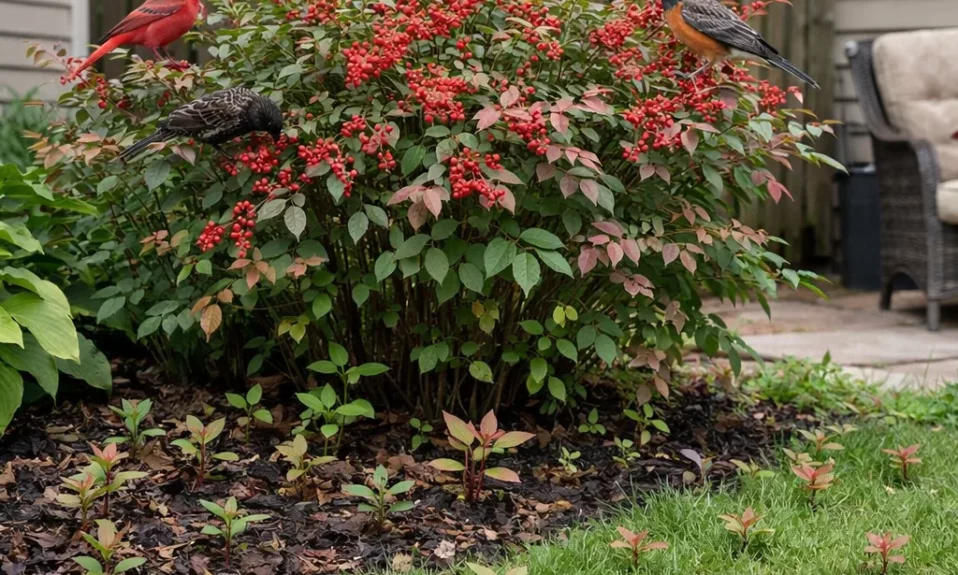
Invasive hedging species — including certain privets, euonymus, nandina, and burning bush varieties — are free at nurseries, widespread in residential gardens, and banned or restricted in dozens of states. They spread via bird-dispersed seeds, crowd out native vegetation, and are documented drivers of biodiversity loss in suburban and peri-urban natural areas.
The regulatory situation is tightening. Some states now require invasive plant removal. The fines are real. And the damage to your property disclosure, which we’ll come back to at #1, is realer still.
Know what you’re planting. And know what it does once you’re not watching it.
12. Encroaching on the Property Line

Your hedge is on your property. Your hedge’s branches are not. Once a hedge grows over, under, or through a fence line, it enters legal grey territory that most homeowners are completely unprepared for.
In most jurisdictions, your neighbour has the right to cut back any encroachment to the boundary line — roots included. They don’t need your permission. What they produce from that cut — a hedge with one side removed — is now your problem aesthetically and structurally.
Survey your property boundary before planting. Plant at least the full mature width away from that line. This is a five-minute check that prevents years of neighbourly friction and a potential boundary dispute at conveyancing.
Your hedge doesn’t know where your property ends. You do.
11. Blocking Sight Lines for Traffic

A hedge that blocks the sight line at a driveway exit or street corner isn’t a landscaping problem. It’s a liability problem.
If a driver pulling out of your driveway cannot see approaching traffic because of your hedge, and an accident occurs, your hedge is now part of a personal injury claim. Many municipalities have height restrictions specifically for vegetation within a sightline triangle at intersections and driveways — restrictions most homeowners have never heard of.
A sight-line violation can void your homeowner’s insurance coverage for a related incident. It can trigger a local authority enforcement notice. It can cost you thousands in legal exposure.
A hedge that looks good is worth having. A hedge that creates a blind spot is worth removing.
10. Root Damage to a Shared Fence

The hedge has been growing alongside the shared fence for eight years. The fence looked fine until the leaning started, and now there’s a panel that’s split at the base. The neighbour is asking who’s going to pay for it.
Hedge root systems planted too close to fence lines will eventually heave the footings of fence posts, warp panels, and compromise the structural integrity of the fence run. On a shared fence, the liability for damage caused by your roots is yours.
Fence replacement on a suburban boundary costs $1,500 to $5,000 depending on materials and length. That’s before you factor in the neighbour relationship, which is harder to price but costs more in the long run.
Plant away from the fence line. Not adjacent to it.
“The next three are where lawyers get involved. Read carefully.”
9. Trimming Your Neighbour’s Side Without Permission

You decided the hedge looked better with the neighbour’s side trimmed back. You leaned over or squeezed through and cut it. This is more legally significant than you probably realise.
In most US jurisdictions, you have the right to cut growth that crosses your property line — back to the boundary, and no further. You do not have the right to enter your neighbour’s property to access and trim their side without permission. Doing so without consent can constitute trespass. Any damage caused to the plant as a result of your cuts is a civil matter.
More practically: you’ve just destroyed your neighbourly relationship over a hedge trim, and the visual result — one side maintained, one side ragged — is now visible from both properties.
Ask first. It costs nothing and prevents everything.
8. Not Checking Local Height Bylaws

You let the hedge get to 8 feet because you wanted privacy. Your municipality’s residential boundary hedge height limit is 6 feet. You’ve been in violation for three years and didn’t know because nobody told you — until your neighbour filed a complaint.
Local hedge height bylaws exist in hundreds of municipalities across the US and are inconsistently publicised. They’re enforced via neighbour complaint. Once a complaint is lodged, you typically receive a notice, a timeframe to rectify, and a fine schedule if you don’t comply.
Hard-cutting a hedge from 8 feet to 6 feet doesn’t look good. And the remaining structure is often permanently compromised.
Check your local code before the first growing season, not after the letter arrives.
7. Planting Near Buried Utilities

You planted along the back fence without calling 811. The gas line runs under that fence line. Three years later the roots have reached the conduit. Excavation to address a utility fault through an established hedge root system adds thousands to a job that would otherwise take an afternoon.
Utility companies are not required to protect your plants. If they need to access buried infrastructure, they will. Your hedge, your investment in it, and your time establishing it become irrelevant.
Call 811 before you plant anything that develops a significant root system. It’s free, it’s legally required before digging in most states, and it takes ten minutes.
Digging without it is not just risky for the plant. It’s risky for everyone.
6. Leaving Dead Patches Unaddressed

The dead patch appeared after that dry summer. You thought it might come back. It’s now been two seasons and the brown gap is permanent. From the street it reads as the single most visible feature of your front yard — not in a good way.
Dead patches in a hedge don’t recover. The dead section needs to be removed, the cause diagnosed and addressed, and either the adjacent plants encouraged to fill in — a process that takes two to four years — or a same-species replacement plant installed.
A buyer’s agent can calculate approximately how long that gap has been there by looking at the neighbouring plants. Dead hedges signal “deferred maintenance” before anyone opens the front door.
Address it the season it appears. The cost of delay is always greater than the cost of action.
5. Choosing a Species That Goes Brown in Winter

You planted for summer. You didn’t think about January. Some species that look magnificent in growing season become a row of bare brown sticks in winter — exactly the season when your house is listed on the market, your street is most visible, and first impressions matter most.
Deciduous hedging has its place in a considered garden design. But planted for privacy or curb appeal without accounting for winter dormancy, it delivers the opposite of what was intended for four to five months of the year.
Buyers viewing homes in winter judge what they see. A dormant, bare hedge against winter-grey sky reads as “dead” to most non-gardeners. It is not a staging asset.
Year-round performance is a feature. Select for it deliberately.
4. A Hedge That Telegraphs Neglect to Buyers

Real estate agents have a phrase for it: “a hedge that’s working against you.” It’s the one that’s been skipped for a season or two — uneven roofline, stray shoots, one side grown wider than the other, a gap the owners stopped noticing because they walk past it every day.
An unkempt hedge at the front of a property signals that maintenance has been deferred across the board. Buyers don’t think “the hedge needs a trim.” They think “I wonder what else hasn’t been done.”
A hedge that looks like it’s being actively managed tells a different story — one of care, attention, and a house worth paying for. The difference in perceived value can be measured in listing price adjustments.
Your hedge is not just a plant. It’s the first sentence of your property’s story.
3. Choosing a Species That Needs Constant Professional Trimming

Leyland cypress grows up to 3 feet per year. It requires trimming two to three times annually to stay manageable in a residential setting. Professional hedge trimming runs $150 to $400 per visit depending on length and height.
Over ten years that’s $3,000 to $12,000 in maintenance costs for a species you chose partly because it was cheap and fast-growing at the nursery. The plant pays nothing. You pay everything.
Fast-growing species create a compounding maintenance burden that most homeowners don’t calculate at the time of planting. When the cost becomes unsustainable, the hedge gets neglected — and neglected Leyland cypress becomes the kind of problem that costs $1,500 just to remove.
The slowest-growing species that meets your screening need is almost always the most cost-effective choice in the long run.
2. Planting Too Close to the Driveway and Blocking Sightlines

You planted it for privacy along the driveway edge. It was fine at two feet. At five feet it became a problem. Now, backing out of the driveway requires a full-faith reversal onto a street you cannot see.
The liability exposure is significant — any incident involving a vehicle exiting your property into traffic where your vegetation contributed to limited visibility can be the basis of a claim against your homeowner’s policy. Some insurers are now specifically asking about boundary vegetation height at driveway exits during policy reviews.
Beyond insurance, local traffic management codes in many municipalities specify vegetation height limits within the sightline triangle at driveway-to-road junctions. A code violation here can trigger an enforcement notice and required removal — at your expense.
It needs to go, or it needs to be hard-cut to a safe height and maintained there permanently.
It’s bad. But it doesn’t come close to what’s waiting at #1.
The Most Expensive Mistake of Them All
1. Planting a Species That’s on Your State’s Invasive Plant List

It was at the garden centre. It had a care tag, a price, and a “recommended for hedging” label. Nobody told you it was listed as invasive in your state. You planted it. It’s been there for seven years.
Here’s what that means now.
Nandina domestica is sold freely in most of the US. It is classified as invasive or a “species of concern” in Florida, Georgia, Tennessee, Alabama, and several other states. Burning bush — euonymus alatus — is restricted or invasive in over 20 states. Japanese barberry, ligustrum, multiflora rose: all available at big-box nurseries, all on state invasive lists somewhere.
When you go to sell, your property disclosure form may require you to declare known invasive species on the property. In states with mandatory disclosure requirements, a hedge you planted and maintained for a decade can become a line item on a legal document that affects your buyer’s financing, your negotiating position, and your closing timeline.
Removal of an established invasive hedge run — roots, rhizomes, and all — costs $800 to $4,000 depending on the species and the size of the established root mass. Some species require follow-up treatment for two to three seasons because they regenerate from root fragments.
The legal situation is tightening. Several states have passed legislation in the last five years expanding both the restricted species list and the disclosure requirements. A plant that was fine to sell in 2015 is now a problem species in 2024 in some jurisdictions.
A retired schoolteacher from Tennessee told me: “We bought the house knowing about the nandina hedge along the back fence. We thought it was pretty. It took three years and nearly $6,000 to remove it completely — and we had to disclose it when we sold. It delayed our settlement by three weeks.”
Look up your state’s invasive plant list before you plant anything. The USDA PLANTS Database is free, current, and takes five minutes. That five minutes is worth more than anything else on this list.
Now you know why we saved this one for last.
Don’t Let Your Hedge Cost You More Than It’s Worth
Every mistake on this list started with a good intention — privacy, curb appeal, a bit of green to frame the house. None of them started with “I want a legal problem” or “I’d like to cost myself $4,000 at the worst possible time.”
The fix for most of these is research before planting, not remediation after. Know your zone. Know your property boundary. Know your state’s invasive species list. Spend $12 on a soil test. Call 811 before you dig.
Your hedge should be one of the easiest features of your property to maintain — if you set it up correctly from the start. The homeowners who are happiest with their hedges didn’t spend more money. They spent more time choosing.