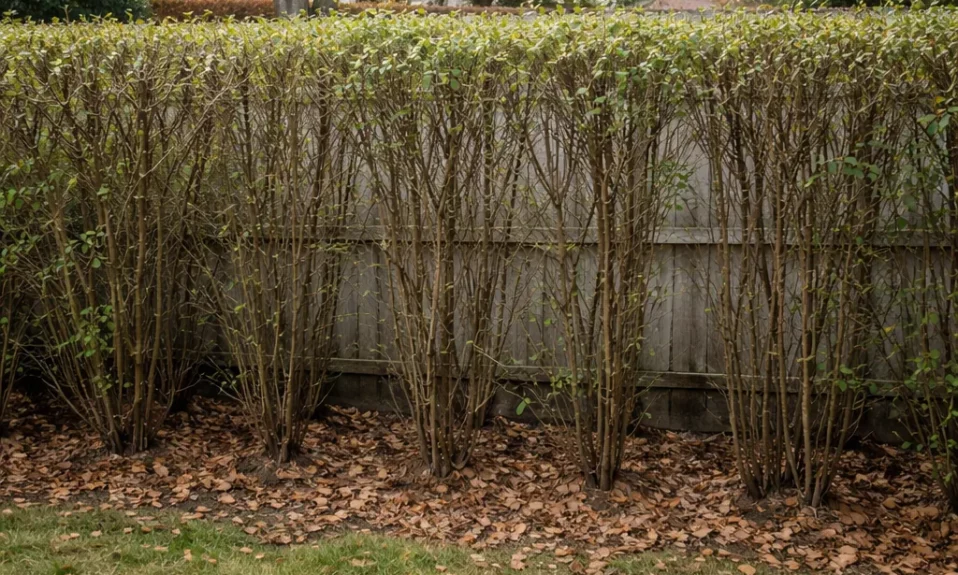
Every spring, millions of Americans buy the wrong plant. The tag says “privacy hedge.” Three years later, they’re staring through skeletal branches at their neighbor’s patio furniture.
Here are 33 of the worst offenders.
33. English Boxwood (Buxus sempervirens)

The nursery tag calls it a “classic hedge plant” and implies neat, dense privacy in a few seasons.
English Boxwood grows at 3 to 6 inches per year. At that rate, a plant purchased at 18 inches reaches 6 feet in roughly a decade — best case.
Most homeowners give up waiting somewhere around year four, when the hedge is still below window height and they’ve trimmed it into a shape that looks more like decorative landscaping than a privacy screen. You can plant it. Just don’t expect privacy before your kids finish middle school.
32. Inkberry Holly (Ilex glabra)

Sold as a native alternative to invasive privets, marketed for “dense, year-round coverage.”
Inkberry grows 4 to 6 inches per year and has a pronounced tendency to go bare at the base. The lower 2 feet of the plant loses foliage as it matures, creating a see-through gap exactly where privacy matters most.
A mature Inkberry hedge at eye level looks like a row of lollipops — solid canopy, bare stems below. The birds love it. Your neighbor can walk straight through the sight line.
31. Cherry Laurel in Cold Zones (Prunus laurocerasus)

Cherry Laurel is sold across the country as an evergreen privacy screen with a reassuring photo of dense, glossy foliage.
In zones 7 and above, it performs reasonably. In zones 5 and 6, where it’s still routinely sold, it suffers significant leaf burn in winter and can die to the ground in hard freezes. Growth is 6 to 12 inches per year in ideal conditions — slower in the cold zones where it’s stressed.
You’ll spend the first two winters convinced it’s dead and the first three summers convinced it’s finally taking off. Then a February cold snap will remind you that the tag didn’t mention the hardiness zone in large print.
30. Photinia (Photinia x fraseri)

“Red-tipped photinia” sounds dynamic, and the tag plays up those vivid new-growth leaves.
Growth is 12 to 18 inches per year, which sounds fast until you realize how open the branch structure is in the first few years. Useful privacy coverage typically requires 5 to 7 years of establishment.
More importantly, Photinia is extraordinarily susceptible to Entomosporium leaf spot, a fungal disease that causes the leaves to drop entirely. In humid climates, an unsprayed Photinia hedge can defoliate by midsummer — not the privacy screen you planned.
29. Viburnum (Viburnum opulus and related)

Viburnums are sold as “privacy shrubs” at box stores nationwide, often grouped with evergreen options.
Most common Viburnum species are deciduous. The “privacy” they offer is seasonal — they’re dense and leafy in summer, bare twigs by November. Growth rate runs 12 to 24 inches per year depending on the species.
If you’re buying a hedge for summer entertaining privacy, Viburnum might work. If you’re buying it for year-round screening, you’ll be staring at your neighbor’s Christmas lights through bare branches every winter.
The next five are a specific kind of failure — they grow, but they grow in the wrong places.
28. Forsythia (Forsythia x intermedia)

Forsythia is sometimes recommended as a fast-growing screening plant, and it is genuinely fast — 24 inches per year is common.
The problem is architecture. Forsythia’s canopy is full at the top, open at the base. At 5 to 6 feet — eye level when seated or standing — you can often see straight through the plant. The density concentrates at 8 to 12 feet, well above where anyone needs screening.
You’ll have a great canopy above fence height and a clear view through it at every height that matters to a person sitting on a deck.
27. Spirea (Spiraea spp.)

Spirea is beautiful. It’s a genuinely reliable landscape plant with good disease resistance and no serious pest problems.
It is not a privacy hedge. Most Spirea species top out at 3 to 5 feet tall with an open, fountaining habit that lets you see through it at every height. It’s sold occasionally as a “border screen,” which is a phrase designed to obscure the fact that you can see straight through it.
Plant Spirea for what it is — a flowering ornamental shrub. Just don’t buy it expecting privacy.
26. Burning Bush (Euonymus alatus)

The fall color on Burning Bush is spectacular, and nurseries lean into that hard. The tag shows a photo of a blazing red wall. What it doesn’t show is what that wall looks like in December.
Burning Bush is deciduous. It drops its leaves completely in winter. As a privacy screen, it functions for approximately 5 months of the year and provides zero screening for the other 7.
It is also classified as invasive in 21 states, including Connecticut, Massachusetts, and New Hampshire, where it is illegal to sell or plant. Check your state’s invasive species list before purchasing.
25. Bradford Pear (Pyrus calleryana ‘Bradford’)

Bradford Pear is not typically sold as a privacy shrub, but it shows up in this role often enough to earn a spot on this list — usually recommended by well-meaning garden center staff as a “fast privacy tree.”
It grows 12 to 15 feet in 5 to 7 years, but its upright, vase-shaped form means the canopy is narrow at the base where you need it. At eye level, the trunk is visible with minimal branching. The “privacy” exists only at 15 feet and above.
It is also classified as invasive in 29 states, prohibited in Ohio since 2023, and structurally prone to splitting at the trunk in storms. A spectacular failure in every way relevant to this article.
24. Tall Ornamental Grasses (Miscanthus sinensis and related)

Pampas grass, Maiden grass, and their relatives are sometimes recommended as fast-growing privacy screens, and they do grow fast — some to 8 or even 12 feet.
The problem is density. Ornamental grasses are clumping plants. They have gaps between clumps that you can see through, and the stems are not opaque. They rustle dramatically in the wind and look striking in a garden. They do not block sight lines.
Additionally, Miscanthus sinensis is listed as invasive or potentially invasive in numerous eastern states. Plant it for texture, not privacy.
This one gets recommended by contractors who should know better.
23. American Holly (Ilex opaca)

American Holly has excellent evergreen coverage once established. The asterisk is massive: once established takes 10 to 15 years.
Growth runs 3 to 6 inches per year. A nursery-purchased plant at 2 feet will reach 6 feet in roughly 10 to 14 years. It’s a beautiful, wildlife-supporting native species that belongs in every yard.
It does not belong on a “privacy hedge” tag marketed to someone who wants screening by next summer. That’s the dishonesty here — not the plant, but what it’s being sold as.
22. Yew (Taxus spp.)

Yew is a legitimately dense evergreen that, when fully established, makes an excellent hedge. The problem is “fully established” is doing a lot of work in that sentence.
Most Yew species grow 3 to 6 inches per year. At that rate, a 6-foot privacy hedge takes 10 to 12 years from a small nursery plant. It also requires annual shearing to stay dense — skip a year and the interior opens up significantly.
Long-term, Yew is a better choice than many plants on this list. Short-term, you’ll be waiting for privacy longer than most homeowners are willing to wait.
21. Arrowwood Viburnum (Viburnum dentatum)

Arrowwood Viburnum is native, wildlife-friendly, and sold enthusiastically at native plant nurseries as a “privacy screen alternative.”
It grows 12 to 18 inches per year and reaches 6 to 10 feet. It is also deciduous, completely bare from November through April, and openly branched at the base in summer. It provides seasonal visual softening, not year-round privacy.
The native plant pitch is real — it does support pollinators and birds. But the privacy pitch is marketing dressed up in ecological language.
20. Wax Myrtle (Morella cerifera)

Wax Myrtle grows fast — 3 to 5 feet per year in the right conditions — and it’s native to the southeastern US. The tag will call it a “screening plant” or “privacy shrub.”
The branch structure is loose and informal. Even at full height, you can see through a Wax Myrtle hedge at multiple points. It requires significant pruning to tighten up, and if you prune it heavily, the growth rate slows considerably.
In the right application — naturalistic screening at a property edge — it works. As a backyard privacy hedge at a suburban property line, it will disappoint you.
19. Rose of Sharon (Hibiscus syriacus)

Rose of Sharon produces stunning flowers in late summer and is marketed as a “privacy hedge” with a straight face by garden centers everywhere.
It is deciduous. It drops its leaves completely by October. It has an upright, open branching habit that provides minimal screening even in full leaf. And it self-seeds prolifically — University of Florida Extension reports each plant can produce up to 25,000 seeds annually, many of which germinate aggressively in garden beds and lawn edges.
It is a beautiful flowering shrub. It is not a hedge. Do not buy it hoping for otherwise.
18. Mock Orange (Philadelphus coronarius)

The fragrance of Mock Orange is genuinely wonderful, and the white flowers in late spring are striking. Which is probably why garden centers occasionally slip it into the “screening shrub” section.
Mock Orange grows 6 to 10 feet tall with an arching, open habit. You can see through it at every height. It is deciduous in most zones. It requires hard pruning every 3 to 4 years to prevent it from becoming a leggy, unmanageable tangle.
Buy it for the fragrance. Put it near a patio where you’ll appreciate it. Do not buy it expecting a fence.
The next group isn’t just disappointing. These plants actively cause damage.
17. Leyland Cypress (× Cuprocyparis leylandii)

Leyland Cypress is the most-planted privacy tree in the United States and arguably the worst large-scale mistake in American residential landscaping history.
It grows 3 to 4 feet per year, which sounds perfect. And for the first 5 to 8 years, a Leyland Cypress hedge looks magnificent — dense, dark green, impenetrable. Then Seiridium canker arrives.
Seiridium canker is a fungal disease that causes branches to turn brown and die in large, spreading patches. There is no cure. Infected trees must be removed. The cost to remove a mature Leyland Cypress runs $400 to $1,200 per tree depending on size and access. Plant a row of 20 and you’re looking at a potential $24,000 removal bill — for a hedge that took 10 years to look right and 2 years to die.
North Carolina State University Extension has documented Seiridium canker as “the primary limiting factor” for Leyland Cypress in the eastern US. It is not a matter of if. It is a matter of when.
16. English Ivy (Hedera helix)

English Ivy is sold as a “ground cover” and occasionally suggested as a fence-covering privacy solution. Both uses are problematic. The second is genuinely irresponsible.
English Ivy is invasive in 17 states and classified as a noxious weed in Oregon and Washington. It climbs trees, smothers understory plants, and creates conditions for “ivy deserts” — monocultures devoid of native biodiversity. Its roots penetrate mortar in brick walls and can cause significant structural damage over time.
The ivy itself is also toxic — all parts of the plant cause contact dermatitis in sensitive individuals, and the berries are toxic to humans and most pets. It is on the “DO NOT PLANT” list of virtually every university extension program in the country. That it is still sold is one of the more baffling facts in American horticulture.
15. Wisteria (Wisteria sinensis and W. floribunda)

Wisteria is sometimes sold and planted as a “privacy screen” on fences and trellises, and for about three years it looks like a brilliant idea.
Then the trunks start to expand. Wisteria stems generate significant mechanical force as they thicken — they have been documented pulling apart pergola joinery, cracking concrete posts, and collapsing light timber structures. Japanese and Chinese Wisteria are invasive in 19 states. They spread aggressively by runners and seed.
Removing established Wisteria is a multi-year project involving repeated cutting and herbicide application. Contractors charge $500 to $2,000 for removal of a single established plant depending on how embedded it has become. This is a plant that wins.
14. Japanese Barberry (Berberis thunbergii)

Japanese Barberry is small, dense, and armed with quarter-inch thorns on every stem. It’s sold as a “low-maintenance security hedge,” which is at least partially honest — nothing will push through it voluntarily.
What the tag doesn’t mention: it’s invasive in 23 states, including banned for sale in New York, Massachusetts, Pennsylvania, and New Hampshire. Research published in the Journal of Medical Entomology found that Barberry thickets increase white-tailed deer tick populations by creating the warm, moist microhabitat ticks require — meaning a Barberry hedge may actively increase Lyme disease risk on your property.
Removal costs $300 to $800 per established shrub due to the root system and the working conditions (thorns through gloves, through skin, through patience). Several states are actively pursuing legislation to mandate removal from public lands.
13. Multiflora Rose (Rosa multiflora)

Multiflora Rose was actively promoted by the USDA Soil Conservation Service in the 1950s and 1960s as a “living fence” solution. This was one of the larger horticultural policy mistakes of the 20th century.
It is now classified as a noxious weed in 11 states and invasive in most of the eastern US. A single plant can produce 500,000 seeds per year. It spreads by birds eating the berries and depositing seeds across the landscape. Once established, it forms impenetrable thickets that crowd out native vegetation across large areas.
If anyone recommends Multiflora Rose to you as a privacy hedge in 2024, they are either uninformed or working against your interests. Walk away.
You might think the worst is behind you. It isn’t.
12. Pyracantha / Firethorn (Pyracantha coccinea)

Pyracantha offers dense coverage, showy berries, and formidable thorns that make it genuinely deterring. It sounds like an ideal privacy hedge.
The thorns that keep intruders out also make routine pruning a miserable and occasionally dangerous task. More importantly, Pyracantha is a magnet for fire blight — the same bacterial disease that devastates apple and pear trees. In humid climates, it can spread fire blight to ornamental fruit trees in neighboring gardens. Once a plant is infected, infected branches must be removed and tools sterilized between each cut.
It also self-seeds aggressively and has been identified as potentially invasive in parts of the Pacific Northwest and California. It’s a plant that trades privacy for an ongoing maintenance commitment most homeowners didn’t sign up for.
11. Heavenly Bamboo / Nandina (Nandina domestica)

Nandina is marketed as a carefree, colorful privacy plant. It’s in virtually every commercial and residential planting in the southern US, which is part of the problem.
Nandina berries contain cyanogenic compounds. The ASPCA lists it as toxic to dogs and cats. More significantly, studies have documented mass die-offs of Cedar Waxwing birds that consume the berries in large quantities during winter food scarcity. It is invasive in Texas, Georgia, and several other southern states.
As a privacy plant, it tops out at 4 to 6 feet with an open, cane-like structure that provides minimal screening. It belongs on this list for both ecological and practical reasons.
10. Oleander (Nerium oleander)

Oleander is sold in garden centers nationwide, including in states where it cannot survive winter outdoors.
It is cold-hardy only to zone 9. Below that, it dies to the ground in a hard freeze and may not recover. Yet it appears regularly at retailers in zone 7 and 8 markets, marketed as a “screening shrub” with no prominent hardiness warning.
Every part of Oleander is toxic — severely so. It is one of the most poisonous plants commonly sold in the US. Ingestion of leaves has caused human fatalities. Smoke from burning branches is toxic. Children and pets in yards with Oleander hedges represent a genuine risk. The American Society of Plant Biologists and the California Poison Control System both document it as a significant household hazard.
In zone 9 and above, it’s a practical privacy option if managed carefully. Anywhere else, it’s a plant that will die and may hurt someone before it does.
The next plants aren’t just bad choices. In many states, you’re not legally allowed to plant them.
9. Common Privet Seedlings (Ligustrum sinense, Chinese Privet)

Chinese Privet grows 2 to 4 feet per year and provides genuinely dense coverage — which explains why it’s still sold. The growth is real. The coverage is real. The problem is what happens next.
Chinese Privet is invasive in 18 states, primarily across the Southeast, where it has invaded 1.2 million acres of forest understory according to the USDA Forest Service. It spreads by bird-dispersed seed and can form monocultures that crowd out native species across entire floodplain systems. The Southeastern US has spent hundreds of millions of dollars on Chinese Privet control.
Removal from a residential property after 10 years of growth costs $800 to $3,000 depending on spread. Stumps re-sprout aggressively from the root system and require repeated cutting or herbicide treatment over 2 to 3 years. It is banned for sale in several states and should be banned in more.
8. Pittosporum (Pittosporum tobira and related) Below Zone 8

Pittosporum is an excellent evergreen screening plant in zones 8 through 11. It is sold regularly in zone 7 markets, where it will die to the ground in most winters and may not recover at all in severe cold snaps.
Growth runs 12 to 24 inches per year in appropriate zones, but a zone 7 plant that dies back every winter and regrows from the base will never build the structure needed for a privacy hedge.
The packaging rarely specifies a hardiness zone range in large, visible print. By the time the plant fails, you’ve waited two years and spent $300 to $600 on plants that need replacing. The garden center has moved on.
7. Leylandii in the Humid South (× Cuprocyparis leylandii, revisited)

Leyland Cypress already appeared at #17 for canker blight — but the situation in the humid South deserves its own entry.
In Georgia, Alabama, Mississippi, Louisiana, and coastal Carolinas, Seiridium canker moves faster and kills more completely than in drier climates. The combination of heat and humidity creates ideal conditions for the pathogen. North Carolina State Extension data shows infection rates approaching 85% for Leylandii in humid southeastern conditions within 15 years of planting.
Homeowners in these states are still routinely sold Leyland Cypress. The average removal cost in the South for a mature Leylandii that has died from canker runs $600 to $1,400 per tree. A 20-tree hedge run — which covers about 120 feet of property line — represents a potential $12,000 to $28,000 failure. This is a known, documented, avoidable disaster.
6. Bougainvillea as a Hedge (Bougainvillea spp.)

Bougainvillea is spectacular in its native climate. In zones 9b through 11, it produces walls of color that legitimately function as privacy screening when trained on a fence or structure.
It is sold at retailers in zone 8 and even zone 7 markets as a “screening vine” with minimal hardiness disclosure. Below zone 9, it dies in hard frosts and cannot be used as a permanent hedge. In zones 8 and below, it can only function as a seasonal annual — you plant it, it grows, it freezes, you replant. That’s not a privacy hedge. That’s an expensive annual.
The thorns are also significant — long, hardened, capable of puncturing skin through garden gloves. If you’re in zone 9b or above, it’s a valid option with structural support. Anywhere else, this purchase ends in disappointment.
5. Japanese Barberry (Revisited for Invasive Status)

Japanese Barberry appeared at #14 for tick habitat concerns. It returns here because its invasive status deserves its own accounting.
Berberis thunbergii is classified as invasive in 23 states. It is banned for sale in New York, Massachusetts, Pennsylvania, New Hampshire, and Minnesota. It has invaded an estimated 26.8 million acres of forest, field, and wetland edges across the eastern US. Each plant can produce thousands of seeds annually, dispersed by birds across wide areas.
In states where it is currently legal to sell, you may legally plant it today and discover it has spread across your neighbor’s fence line within five years. Your neighbor can take legal action. HOAs in affected states have specific ordinances covering invasive species, and violations can result in mandatory removal at the homeowner’s expense. The plant you bought at Home Depot for $18 can generate a legal dispute worth thousands.
4. English Ivy (Revisited for Legal and HOA Risk)

English Ivy at #16 covered the ecological damage. Here, we need to address the neighbor and legal dimension specifically.
English Ivy is listed as a Class B noxious weed in Oregon and Class C in Washington. It is prohibited for sale in Oregon. In Portland and Seattle, there are active ivy removal programs with associated regulations. Planting it near a property line is planting a problem for your neighbor — and in regulated jurisdictions, they have legal recourse.
Ivy spreads underground by runners and over fences by stem growth. Once it crosses your property line, your neighbor has a valid complaint. In communities with active HOA governance, planting a species on the invasive list can result in mandatory removal notices and fines. Several homeowners in the Pacific Northwest have faced five-figure legal disputes over ivy spread. Know your local regulations before this plant goes in the ground.
3. Multiflora Rose (Revisited for Spread and Legal Status)

Multiflora Rose at #13 covered its history. Here we need to be specific about current legal exposure.
Multiflora Rose is declared a noxious weed in 11 states: New Jersey, Pennsylvania, Ohio, Iowa, Indiana, Missouri, Arkansas, Kansas, Nebraska, Virginia, and Wisconsin. In most of these states, landowners are legally required to control or eradicate it. Planting it knowingly in these states may expose you to regulatory action.
Beyond legality: a single Multiflora Rose plant produces 500,000 seeds per year. Birds disperse the seeds widely. Within 5 years of planting, you may have seedlings appearing across a 1-acre radius. The canes root where they touch the ground. A “privacy hedge” of Multiflora Rose becomes a landscape-scale eradication problem. Several eastern counties have documented Multiflora Rose as the primary invasive species displacing native shrub communities.
2. Common Privet (Ligustrum vulgare)

Common Privet grows 12 to 18 inches per year. It’s semi-evergreen — in zones 6 and above it holds most of its leaves through winter. It reaches a useful privacy height in 4 to 6 years. On paper, it sounds acceptable.
In practice, it is invasive in 38 states according to the USDA PLANTS Database. It is listed as a noxious weed in multiple states. It spreads aggressively by bird-dispersed seed, producing seedlings across an expanding radius from any established planting. In the Mid-Atlantic and Southeast, it has colonized forest edges, roadsides, and disturbed areas at scale.
Its branch structure is open at the base, particularly in shade. The “dense hedge” it provides is denser at the top than at eye level, creating the familiar frustration of a hedge that looks solid from the street and see-through from your deck. It attracts aphids, which attract wasps. The flowers produce an odor that many people find strongly unpleasant. It cross-pollinates with other Ligustrum species, spreading hybrid variants that are even more aggressive.
It’s bad. But it doesn’t come close to what’s waiting at #1.
1. English/Common Privet (Ligustrum vulgare) — The Most Widely Sold

The Most Deceptive Plant in American Garden Centers
The tag says “privacy hedge.” It’s at the front of the garden center, probably with a sale sticker.
This is Ligustrum vulgare — Common or English Privet. It is the #1 bestselling “privacy shrub” at garden centers across the United States, available at Home Depot, Lowe’s, Walmart, and independent nurseries in virtually every state. The plants look healthy, the price is accessible, and the tag makes a specific promise.
Here is what the tag does not say.
Ligustrum vulgare is listed as invasive in 38 states by the USDA PLANTS Database — more states than any other “privacy” plant commonly sold in the US. It is classified as a noxious weed in Ohio, Tennessee, and New Jersey. It has been documented invading forest understory, riparian corridors, and natural areas across the eastern and central US, outcompeting native vegetation including native shrubs, wildflowers, and tree seedlings.
It grows 12 to 18 inches per year. At the low end — which is what you get in partial shade, poor soil, or zone 5 — a plant reaching 6 feet of useful density takes 5 to 7 years. That is not fast. That is most of an elementary school career.
In zones 5 and below, Ligustrum vulgare is semi-deciduous to fully deciduous. It drops its leaves in winter, leaving you with bare twigs at the property line during the months when a fence would be most valued.
The mature hedge that grows in has open branching at eye level. Dense at 8 feet. Sparse at 5 feet. Exactly backwards from what you need.
Sandra M., a landscape designer in Virginia, put it plainly: “I spend more time on Privet removal than any other plant. Homeowners planted it ten years ago because the garden center said it was fast and private. Now they want it gone because it’s spreading into their neighbor’s yard, it’s listing as invasive in the news, and the HOA has flagged it. The removal is $1,500 to $4,000 depending on how far it’s spread. And they still can’t figure out why someone sold it to them in the first place.”
The alternative: Green Giant Arborvitae (Thuja standishii × plicata ‘Green Giant’). Grows 3 to 5 feet per year — genuinely fast. Fully evergreen, dense from ground to tip, no seasonal gaps. Non-invasive, not listed as problematic in any US state. Widely available at $40 to $60 per plant at establishment size. Plant it 5 to 6 feet apart and you have a legitimate privacy screen in 2 to 3 years.
The difference in outcome between Green Giant and Common Privet is the difference between problem solved and problem created.
Now you know why we saved this one for last.
What Actually Works: 3 Privacy Plants That Deliver
After fifteen years of watching the wrong plants fail, here are the three that consistently work.
Green Giant Arborvitae (Thuja ‘Green Giant’) is the gold standard for residential privacy screening in zones 5 through 9. It grows 3 to 5 feet per year, stays dense from the ground up, and has no significant pest or disease issues. Plant 5 to 6 feet apart on center. Within 3 years, you have a genuine screen.
Sky Pencil Holly (Ilex crenata ‘Sky Pencil’) works in tighter spaces — it grows in a narrow, columnar form to 8 to 10 feet with minimal spread. It’s evergreen, non-invasive, and deer-resistant. Ideal for side yards, narrow easements, or situations where a full hedge would encroach on space.
Nellie Stevens Holly (Ilex × ‘Nellie R. Stevens’) is the best option for the Southeast, where humidity and heat make many conifers difficult. It grows 3 feet per year, stays dense at eye level, and is widely available at southern nurseries. Fully evergreen, reliable to zone 6.
None of these are the cheapest plant at the garden center. None of them will make a dramatic photo on the nursery tag. But five years from now, you’ll have a privacy screen instead of a problem — and that is exactly what you were trying to buy in the first place.