26 Cozy Farmhouse Kitchen Ideas That Make Your Kitchen Feel Like the Heart of the Home Again

There’s a version of your kitchen that you fell in love with, or maybe one you always imagined having.
It doesn’t look like a magazine spread. It looks like somewhere real people actually cook.
Somewhere the coffee is always hot, the kids know where to find the snacks, and the smell of something slow-cooking follows you from room to room.
That kitchen has a name. It’s called a farmhouse kitchen, and it doesn’t require a gut renovation to get there.
I know because I’ve spent the last three years paying attention to what actually changes the feeling of a kitchen — not what looks good in a photo, but what makes you exhale when you walk in.
Some of these are a weekend project. Some cost less than a dinner out. A few of them will make you wonder why you waited so long.
I’ve ranked them from good to extraordinary, starting at 26 and counting down to the one thing that changed everything for me.
Go slowly. The best ones are toward the bottom, and the last one on this list is the reason the article exists.
26. A Jute or Woven Runner Rug on Hardwood or Tile Floors
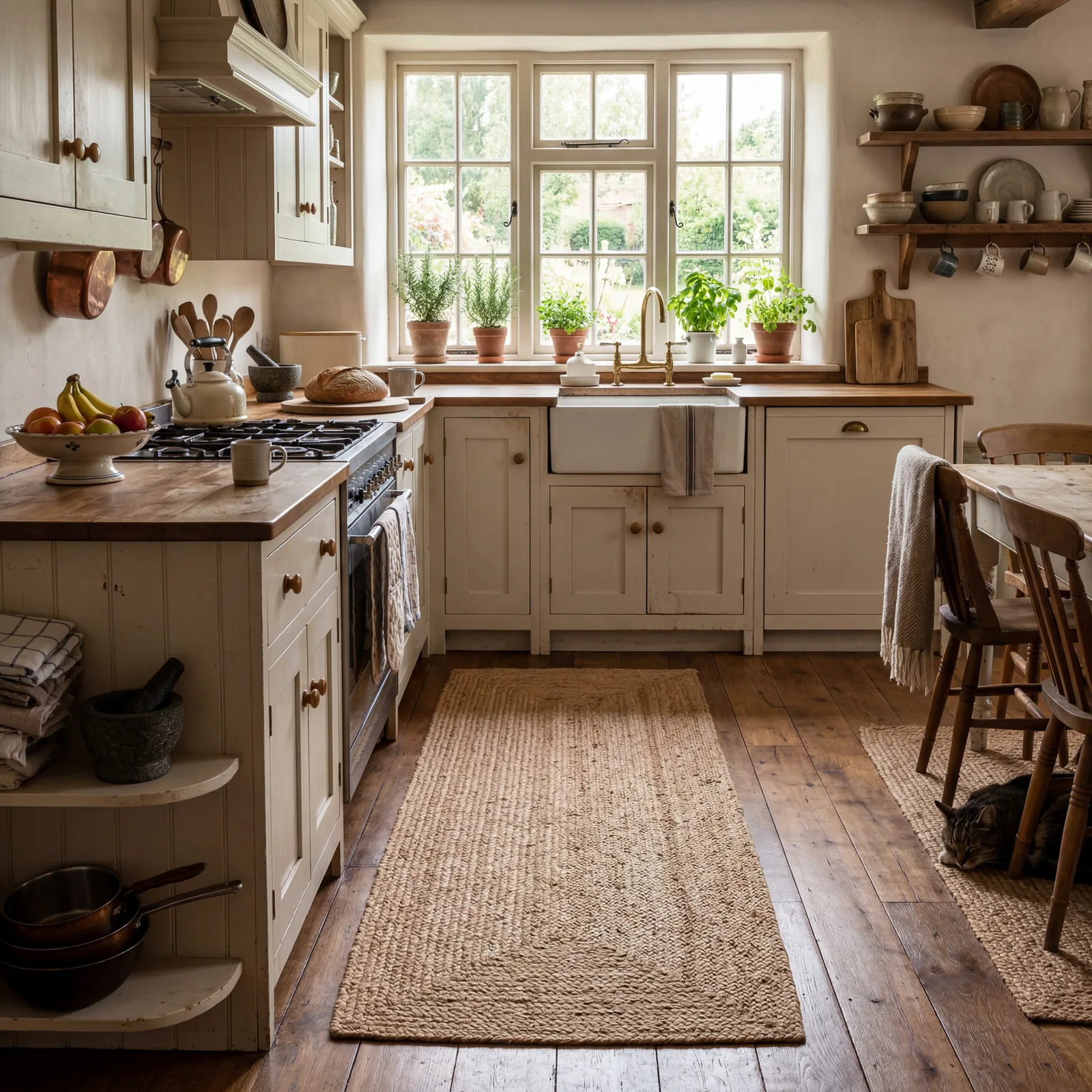
Nobody ever says “the rug is what made the kitchen.”
But pull one out and you’ll notice immediately. A natural jute or woven cotton runner laid in front of the sink or along the main work zone instantly softens the whole room. It’s the difference between a kitchen that echoes and one that feels settled.
A $35 jute runner from Amazon or Ruggable does the job. Aim for 24 x 72 inches for a standard run in front of the sink. Go for natural tones: oatmeal, wheat, or biscuit.
The rug doesn’t decorate the kitchen. It makes the kitchen feel like it was decorated on purpose.
25. Open Shelving Replacing Upper Cabinets (or Some of Them)

The upper cabinets are lying to you about what’s inside them.
Open shelves force a kind of honesty: you only keep what’s worth looking at. White stacked bowls, a row of mason jars, a few plants. The room immediately feels lighter, more considered, more like a kitchen someone actually loves.
Floating wood shelves in 1.5-inch pine or walnut typically run $40–$80 per shelf installed. Pull two or three upper cabinets on one wall and replace them with three staggered shelves.
What you display says more about your kitchen than any cabinet door ever could.
24. Mason Jar Storage for Flour, Sugar, Oats, and Dry Goods
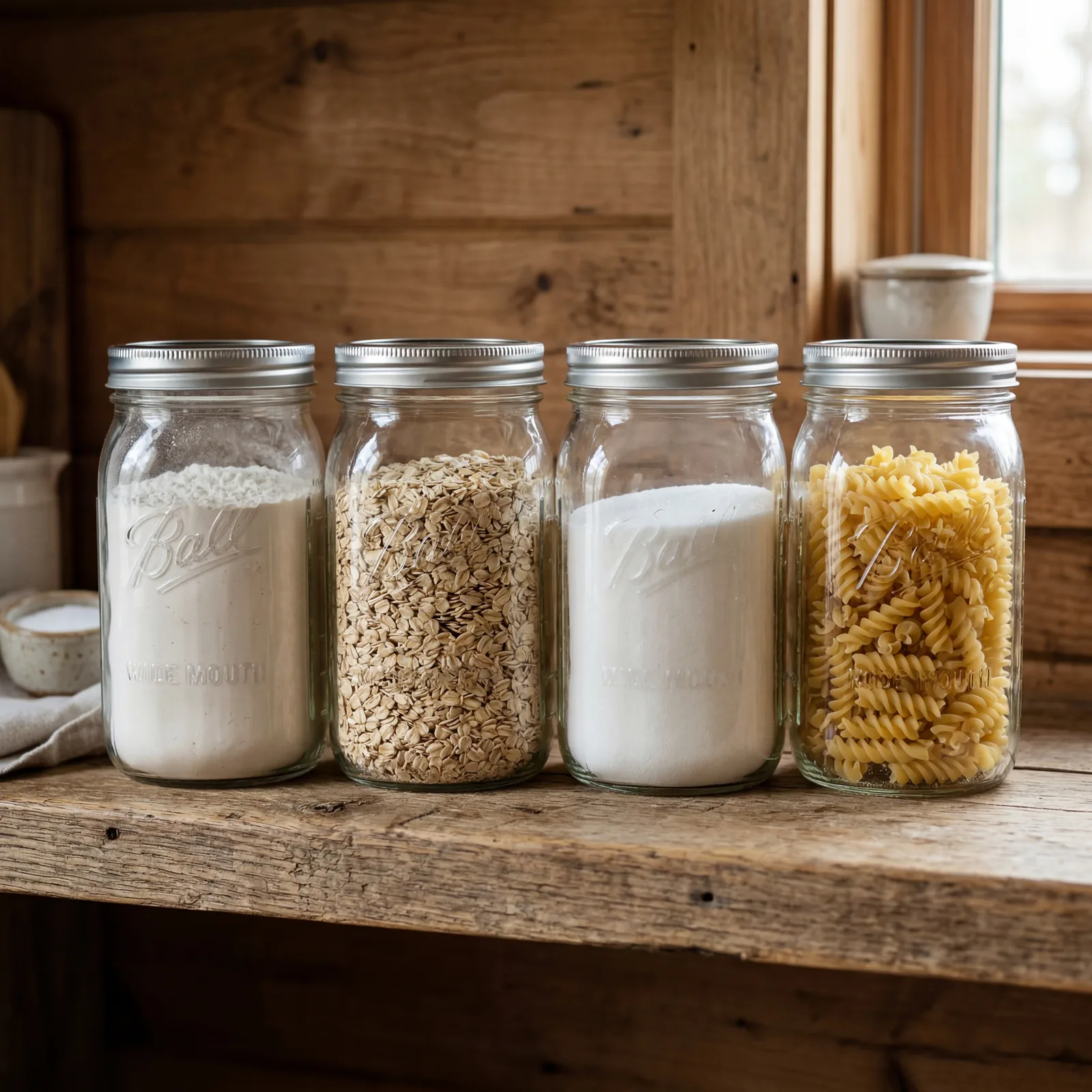
The plastic containers your dry goods live in are making your kitchen feel like a pantry closet, not a kitchen.
Transfer your flour, sugar, oats, lentils, and pasta into wide-mouth Ball mason jars and line them up on a shelf or the counter. They catch the light. They tell you when you’re running low. They look like someone thought about this kitchen.
A 12-pack of wide-mouth quart jars runs about $18. Label them with a paint pen or a small chalkboard tag.
It’s the smallest possible change, and somehow one of the most visible ones.
The next one costs almost nothing and changes the feel of the whole room.
23. Vintage-Style Pendant Lights Over the Island or Sink
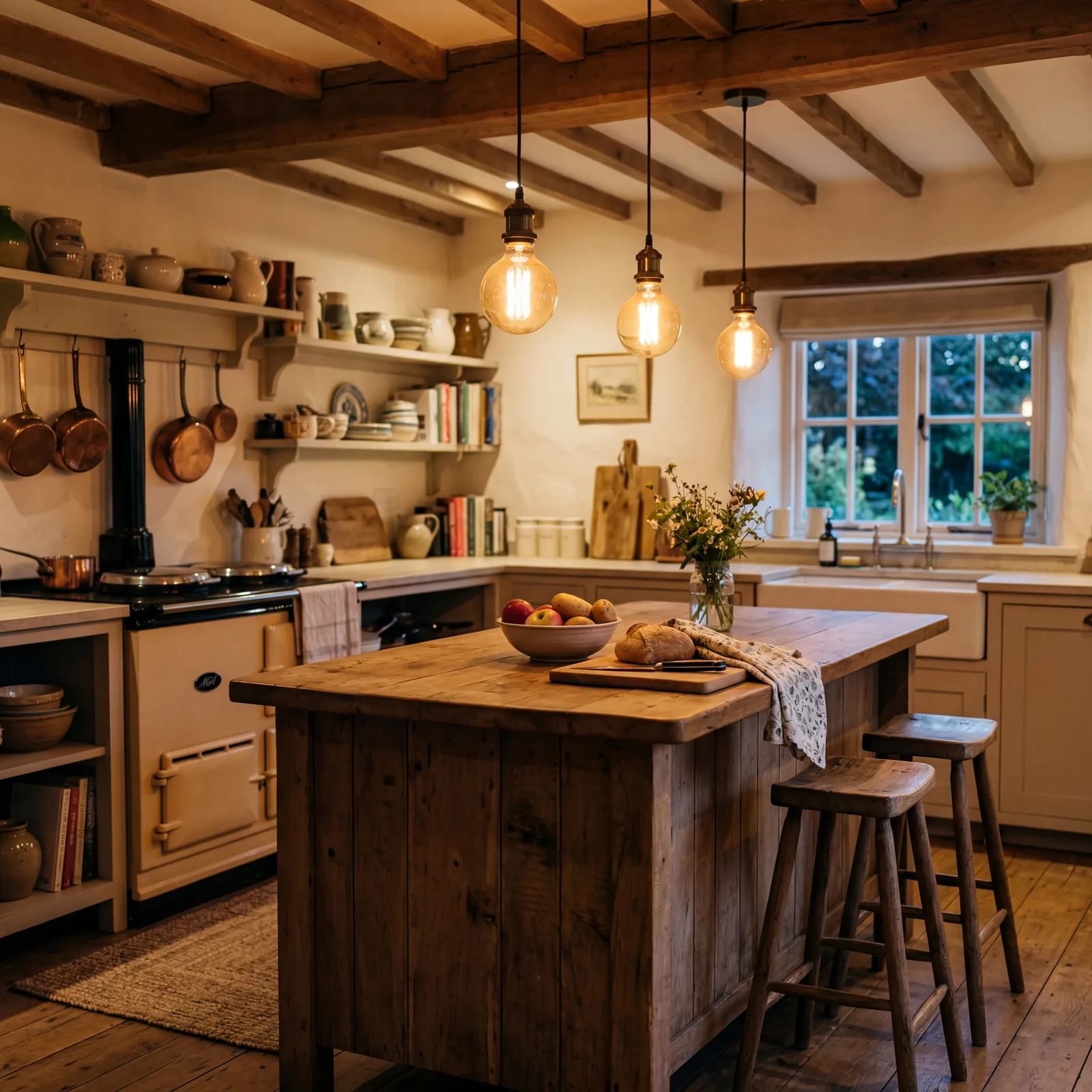
The light fixture you chose when you moved in is probably the one thing in your kitchen you’ve never thought about since.
A vintage-style pendant — rattan shade, wire cage, or clear glass with an Edison bulb — changes the warmth of the whole room. Swap one overhead can light for a pendant above the sink and the kitchen shifts from functional to intentional.
Rattan pendant lights from Wayfair or World Market run $45–$90 each. A pair over an island is the standard move, but even one above the sink is enough.
Good light doesn’t just illuminate a room. It decides how the room feels.
22. Wooden Cutting Boards Displayed Upright on the Counter
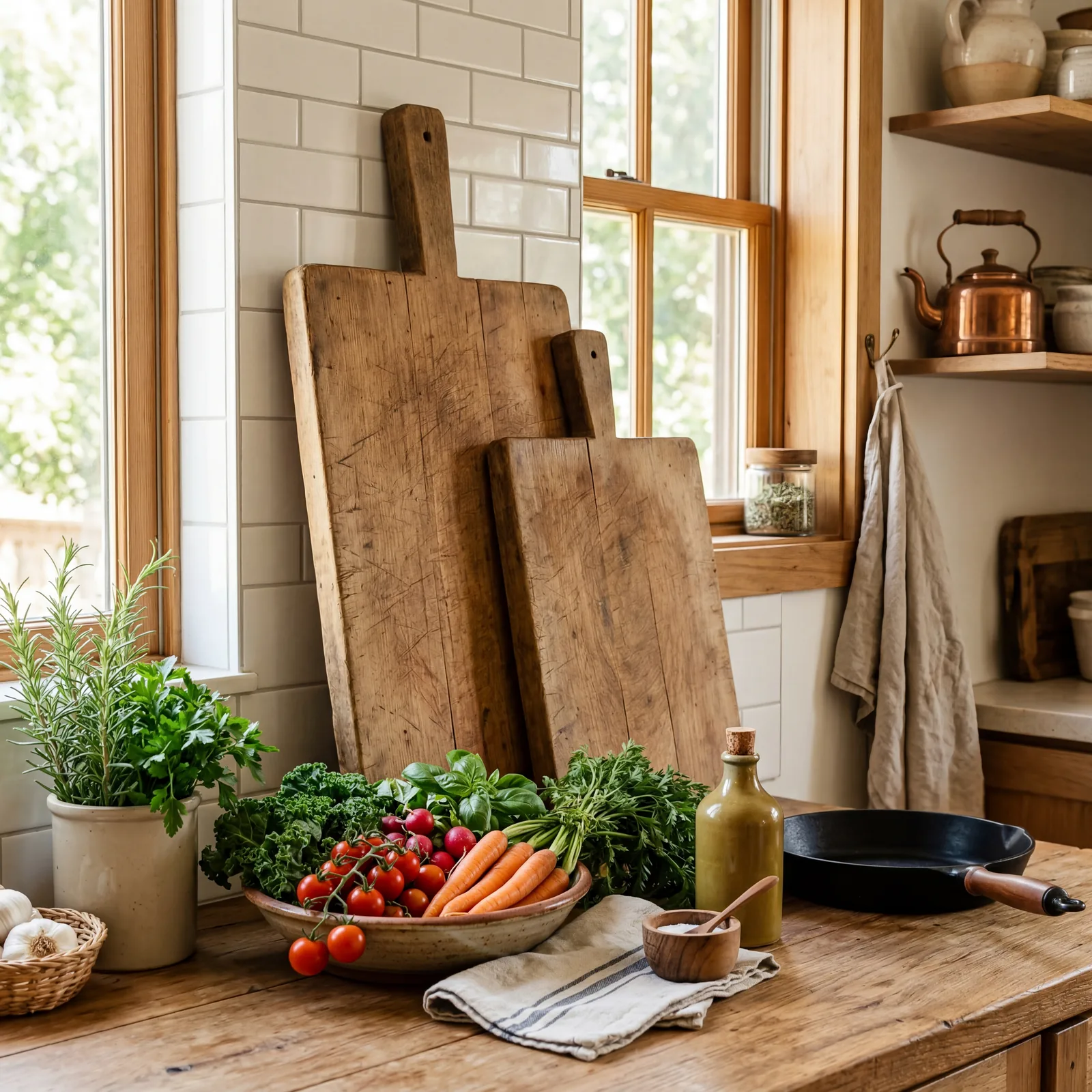
Cutting boards left flat on the counter look like clutter. Stood upright against the backsplash, they look like they were meant to be there.
One or two large end-grain or edge-grain wooden boards — walnut or maple — leaned against the tile creates an instant visual anchor on the counter. They’re functional, they’re beautiful, and they communicate that someone in this house actually cooks.
A solid John Boos maple board runs $60–$120, but a well-oiled board from HomeGoods or TJ Maxx does the same visual work for under $30.
A cutting board that never moves still belongs in the kitchen.
21. White Subway Tile Backsplash (Simple, Classic, Timeless)
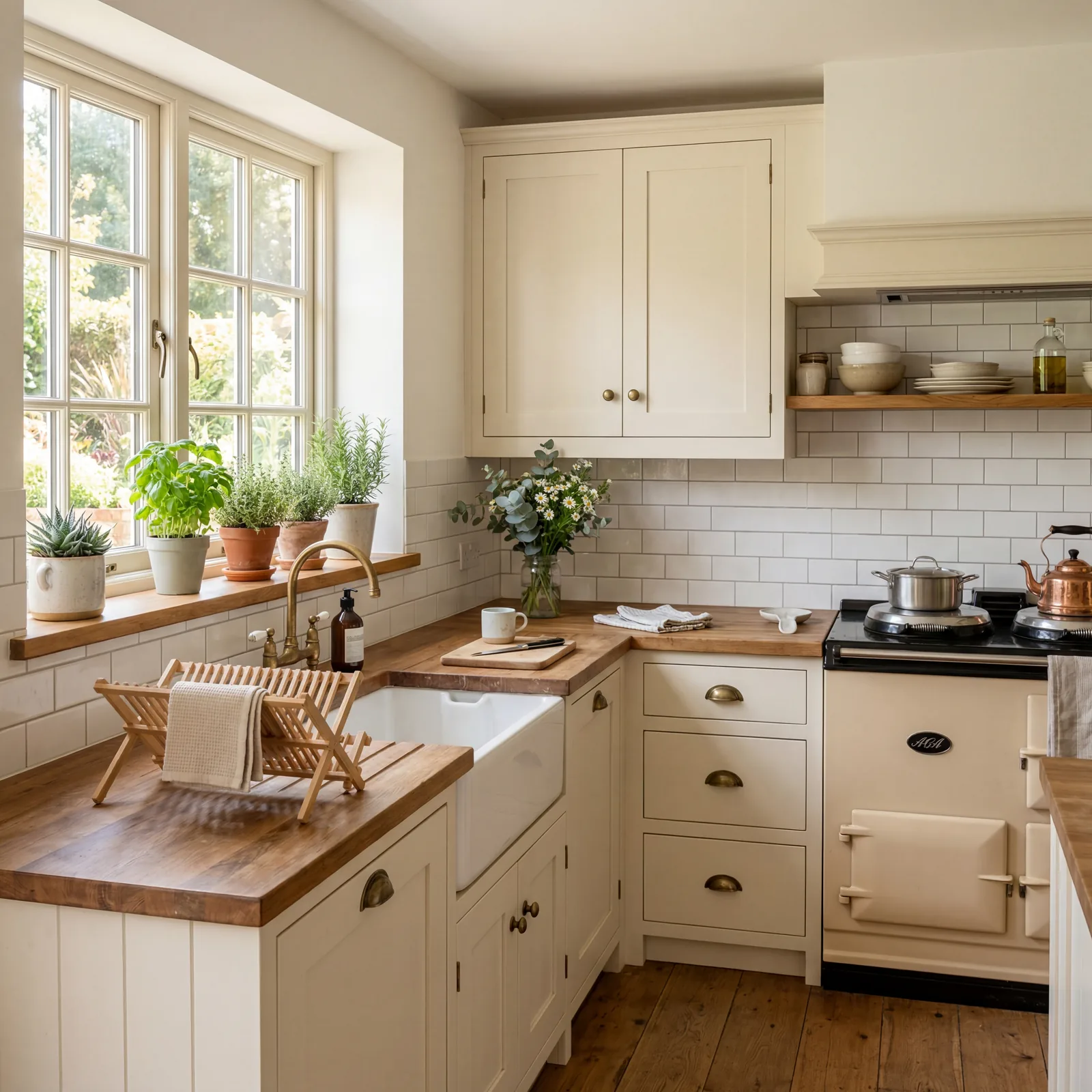
There is something quietly radical about choosing the most classic option when everyone around you is overthinking it.
White 3×6 subway tile with light grey grout doesn’t photograph dramatically, but it makes every other element in your kitchen feel more intentional. It’s a background that knows it’s a background. Creamy cabinets look creamier against it. Wood tones warm up next to it.
Subway tile typically runs $1.50–$4 per square foot. A standard backsplash area of 30 square feet costs $50–$120 in tile, plus grout and installation if you’re not DIY-ing it.
The best kitchen decisions are the ones you never have to make again.
20. A Window Box Herb Garden Above the Kitchen Sink
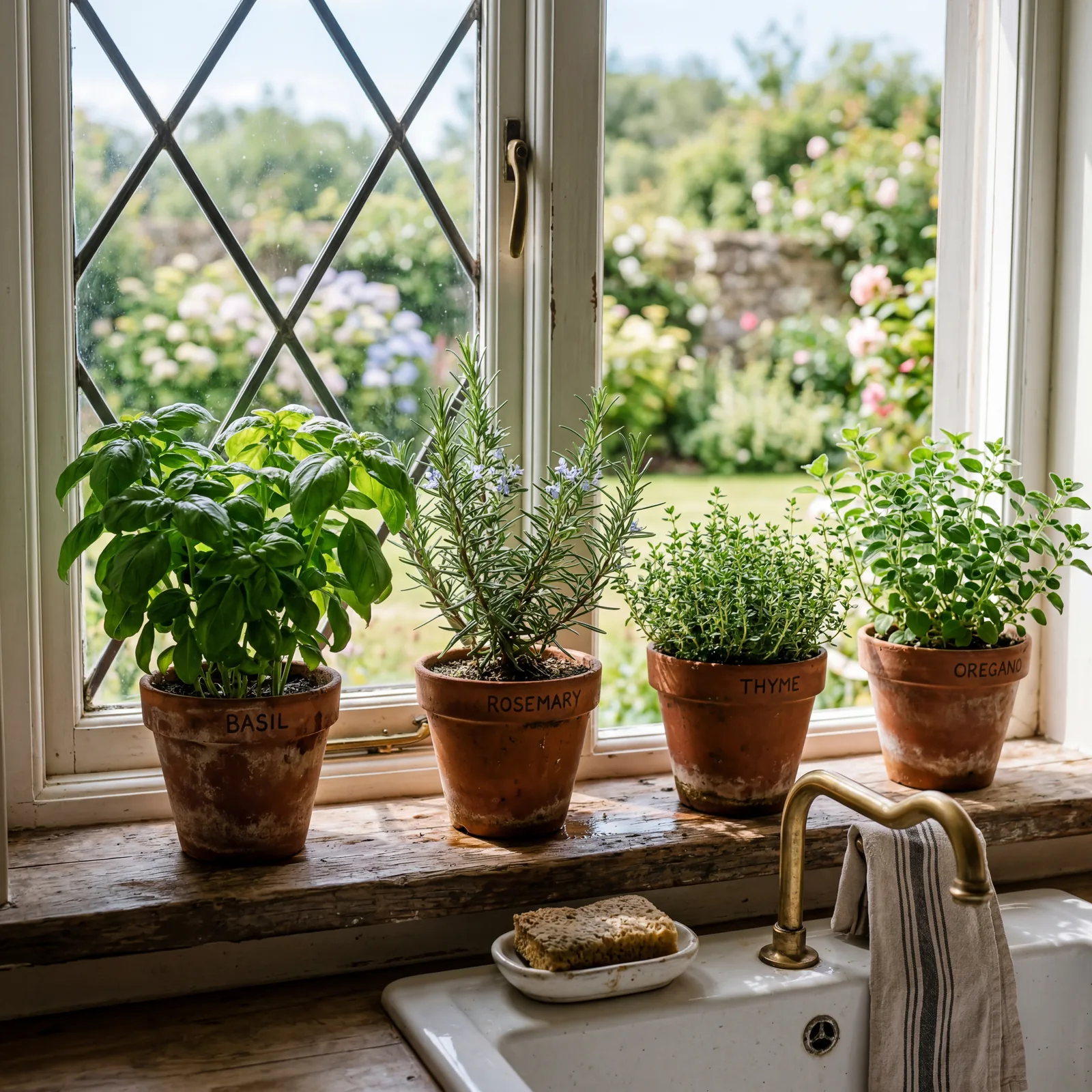
You already stand at the sink every day. The question is what you’re looking at while you do it.
A small window box or a row of terracotta pots with fresh basil, rosemary, thyme, and mint above the sink does two things: it gives you something alive and green to rest your eyes on, and it means fresh herbs are always within arm’s reach when you’re cooking.
Four terracotta 4-inch pots cost about $12 at any garden center. A small window box shelf bracket kit runs $18–$25 on Amazon.
A kitchen with something growing in it always feels inhabited in the best way.
This next idea is one kitchen designers install in their own homes.
19. Painted Kitchen Island in a Contrasting Color (Navy, Forest Green, Slate Grey)
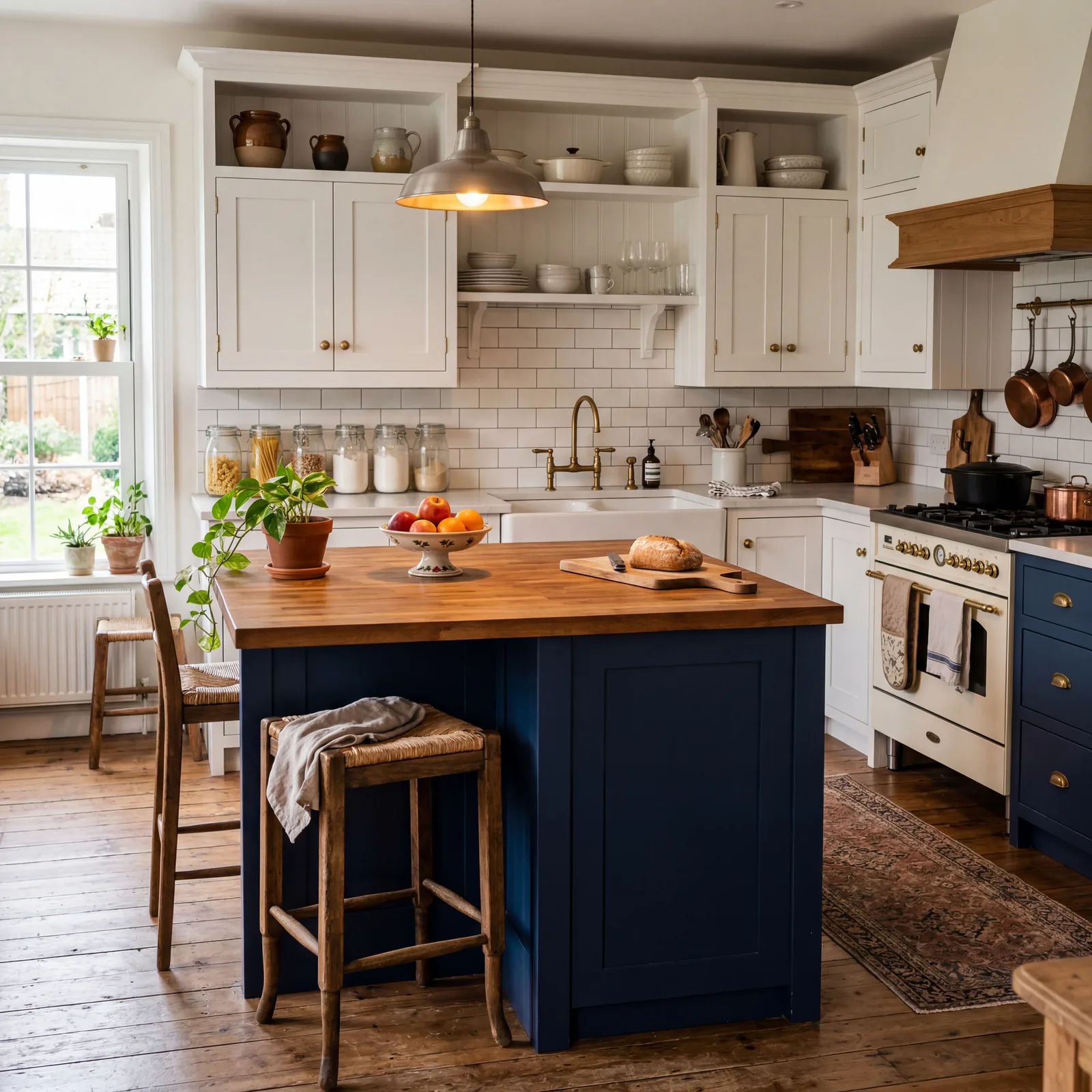
The single coat of paint your island has never received is doing nothing for your kitchen.
A contrasting island color — Benjamin Moore Hale Navy, Sherwin-Williams Pewter Green, or Behr Cracked Pepper — grounds the whole room and gives it a visual center of gravity. White or cream cabinets feel deliberately chosen next to a deep navy or forest green island, rather than just default.
One quart of cabinet-grade paint covers a standard island for about $25–$35. Use a satin or semi-gloss finish for durability. Sand lightly and prime first.
The island that used to disappear into the kitchen will suddenly be the whole point of it.
18. Beadboard Cabinet Faces on Lower Cabinets
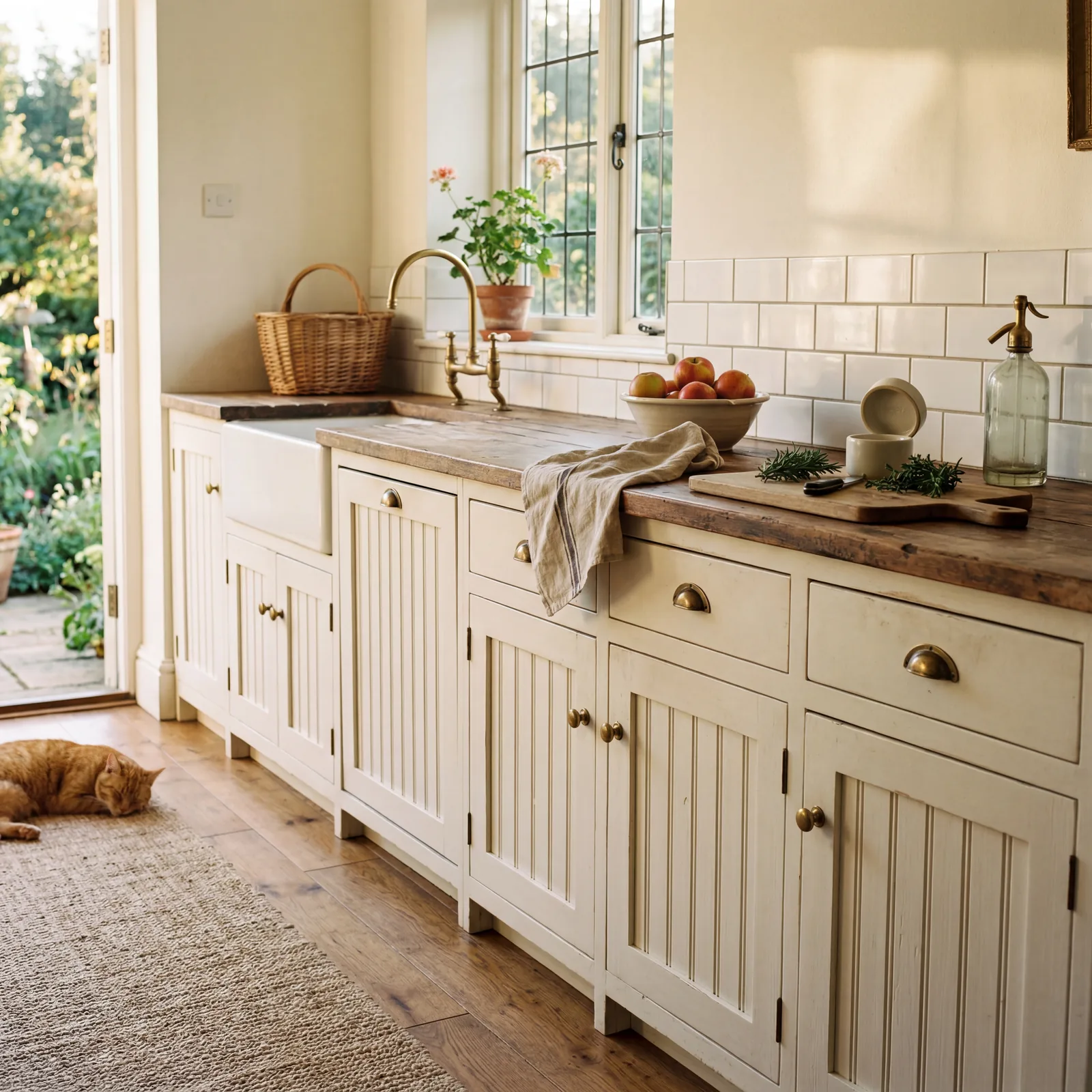
Your lower cabinet doors are flat rectangles that communicate nothing at all.
Beadboard panel inserts routed or overlaid onto flat cabinet doors adds instant farmhouse character at low cost. The vertical grooves read as old-house detail — the kind of thing you’d find in a 1920s craftsman kitchen or a restored Vermont farmhouse.
Beadboard MDF sheets run $18–$30 for a 4×8 sheet, enough to resurface four to six cabinet doors. Cut to size, glue, and paint. Total project often lands under $100 for a standard lower cabinet run.
A flat door tells you nothing. A beadboard door tells you someone cared enough to choose.
17. Antique or Vintage-Style Hardware in Brass or Oil-Rubbed Bronze
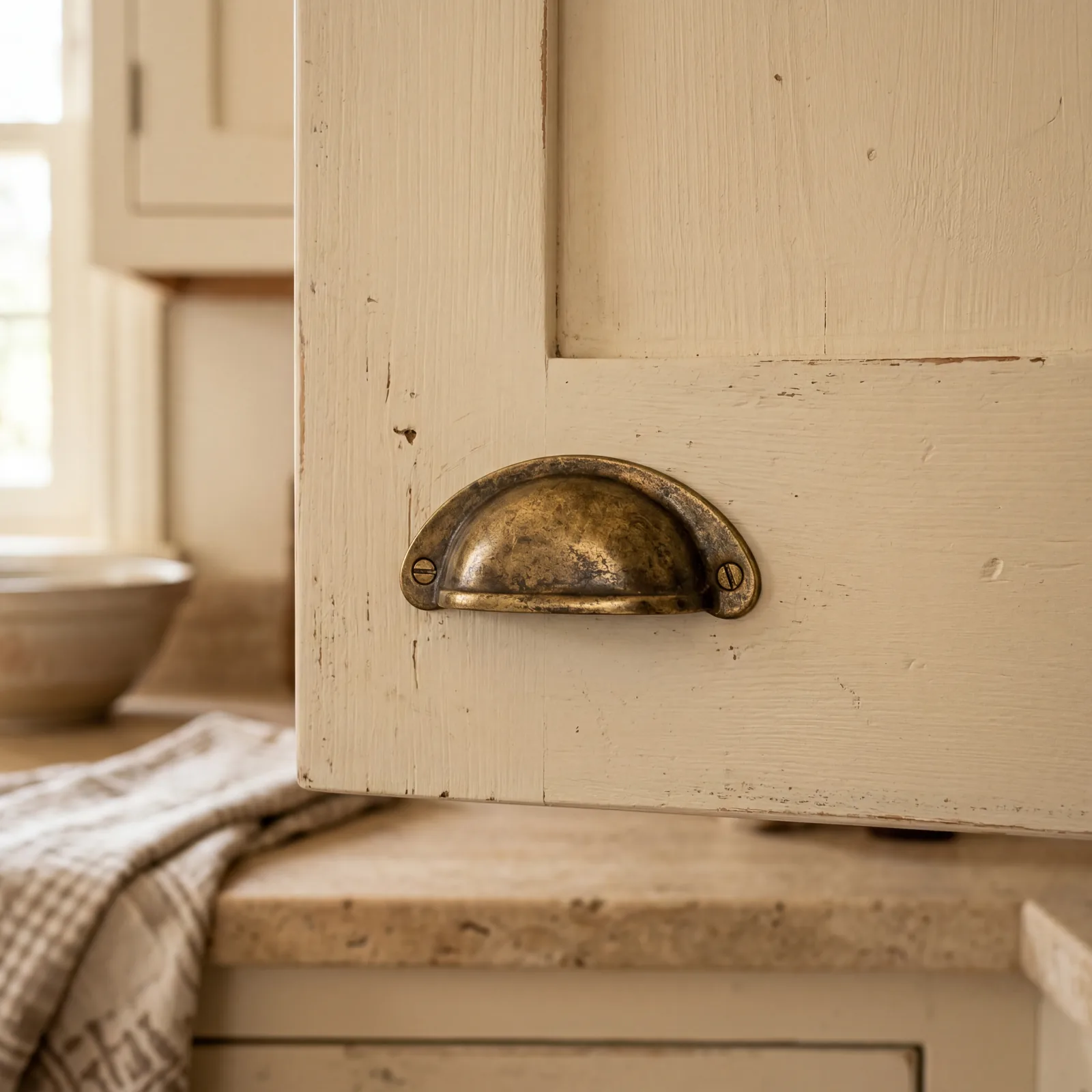
You probably haven’t looked at your cabinet hardware in years. That’s exactly the problem.
Swapping builder-grade brushed nickel knobs for antique brass cup pulls or oil-rubbed bronze bin pulls takes about forty minutes and no tools you don’t already own. The hardware is the jewelry of the kitchen — swap it and suddenly the whole room looks more finished.
Cup pulls run $2–$6 each from Rejuvenation, Amazon, or Wayfair. A kitchen with 20 cabinets costs $40–$120 total. Pick one finish and use it everywhere, including the faucet and light fixture.
Hardware is the smallest detail that everyone notices and nobody talks about.
This next one sounds like a weekend project. It’s actually an afternoon.
16. Linen or Cotton Curtains at the Kitchen Window Instead of Blinds
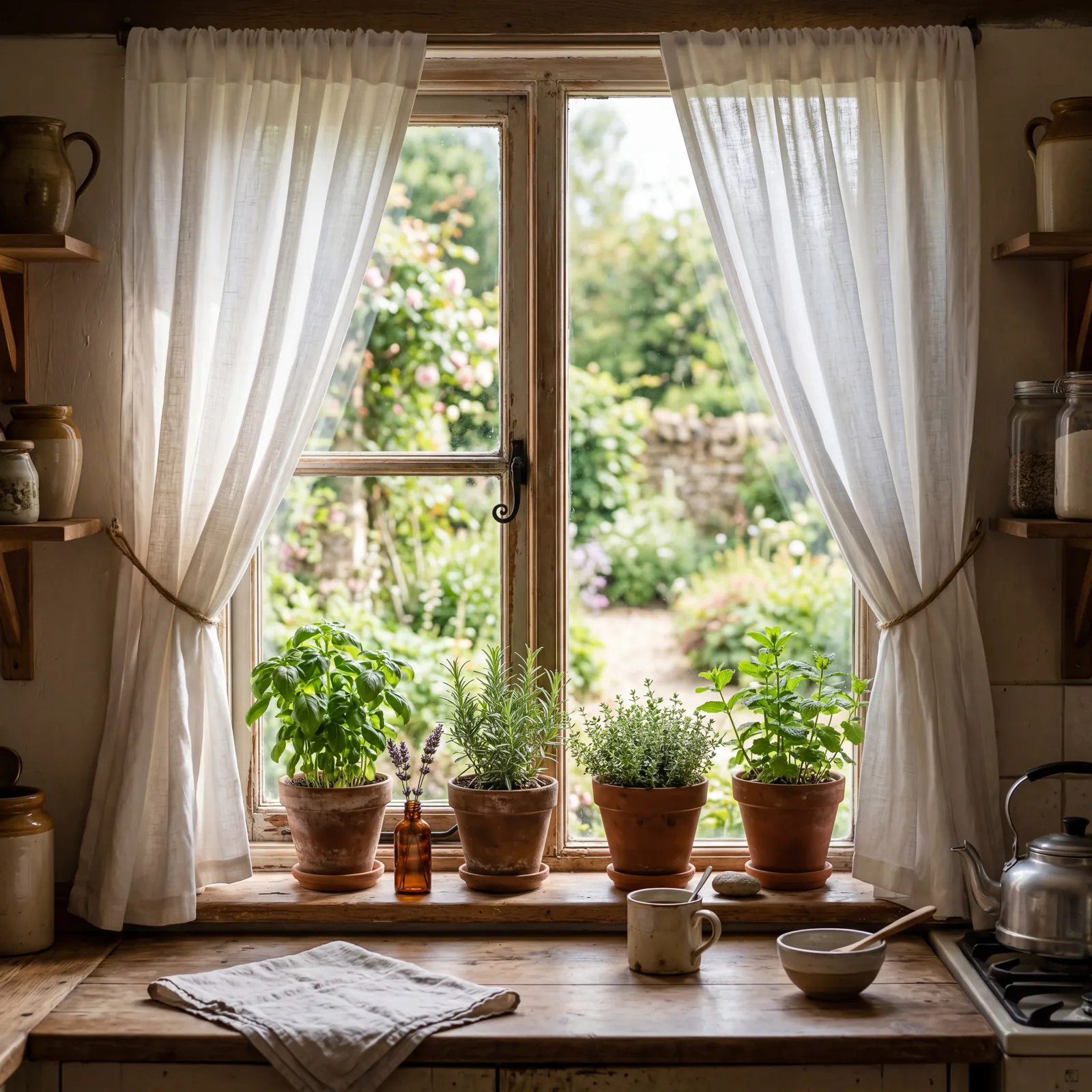
The plastic blinds on your kitchen window are doing the minimum required.
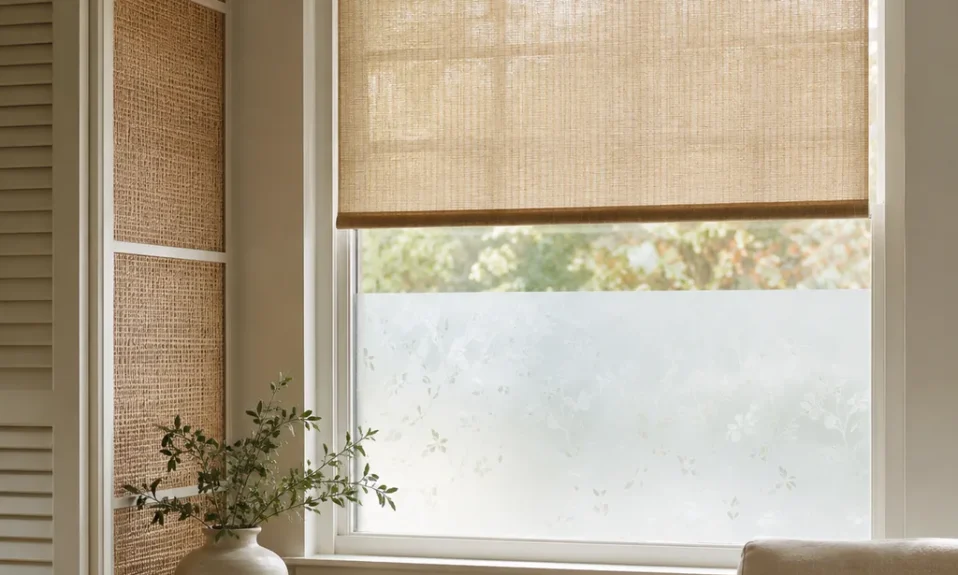
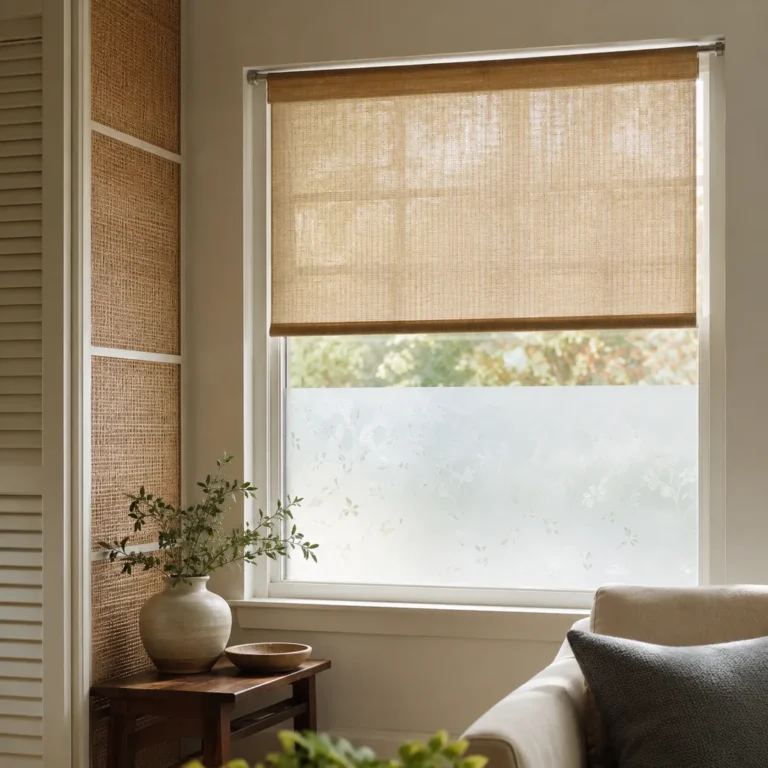
White or natural linen panels on a simple rod, left slightly open, filter the light in a way that plastic blinds cannot. The room warms up. The window becomes part of the room instead of just a gap in the wall.
IKEA’s AINA linen curtain panels run $30–$50 per pair, and they’re long enough to hang high above the window frame to make the ceiling feel taller. Use a simple black or brass tension rod.
A window with fabric on it looks like someone lives there. A window with plastic blinds looks like somewhere you’re visiting.
15. A Cast Iron Pot Rack Hanging from the Ceiling
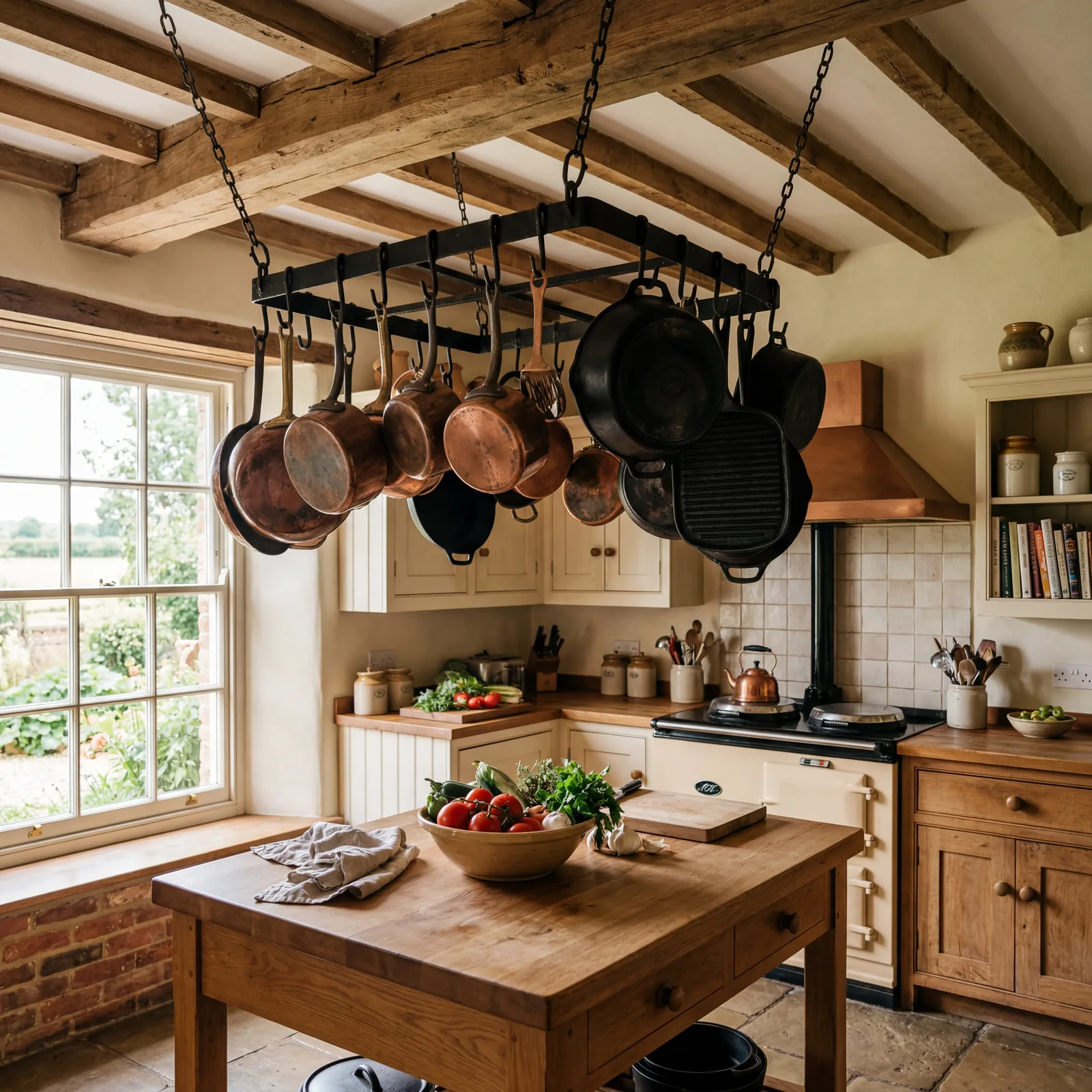
Every farmhouse kitchen photograph you’ve ever saved probably has a pot rack in it, and you’ve been telling yourself it’s too much trouble for three years now.
A ceiling-mounted oval or rectangular pot rack in black iron or oil-rubbed bronze does two things at once: frees up your cabinet space and turns your cookware into decor. Cast iron and copper pans hang beautifully. Even stainless is fine against the right background.
Enclume ceiling pot racks run $150–$280 and mount to ceiling joists. Installation takes about two hours with a stud finder and a drill. The rack holds up to 200 pounds.
Your pots belong where you can see them, not stacked in a cabinet you have to unpack every time.
14. A Large Farmhouse-Style Wall Clock
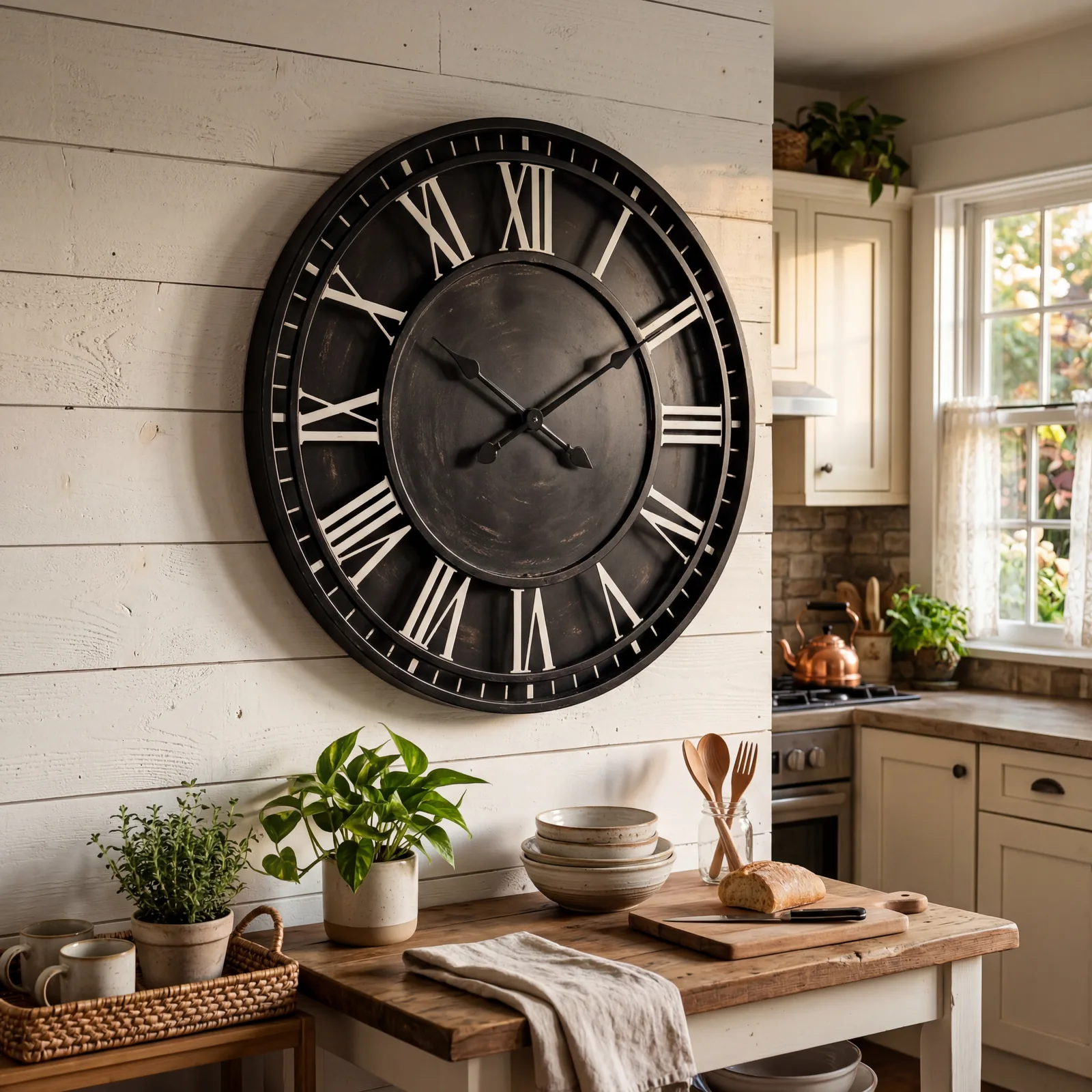
A kitchen without a wall clock is a kitchen that feels like it’s waiting to become something.
A large 24-inch or 30-inch farmhouse clock in distressed black or antique white anchors an empty wall and gives the room a sense of settled permanence. It communicates: this kitchen has been here a while, and it knows what it is.
Uttermost and Laurel Foundry make farmhouse wall clocks in the $60–$120 range. Hang it on the wall opposite the window so it catches the light. Go bigger than you think — a 24-inch clock looks small from across a room.
The clock that’s always there is the one nobody notices is missing until it’s gone.
13. Exposed Wooden Ceiling Beams (Faux or Real)
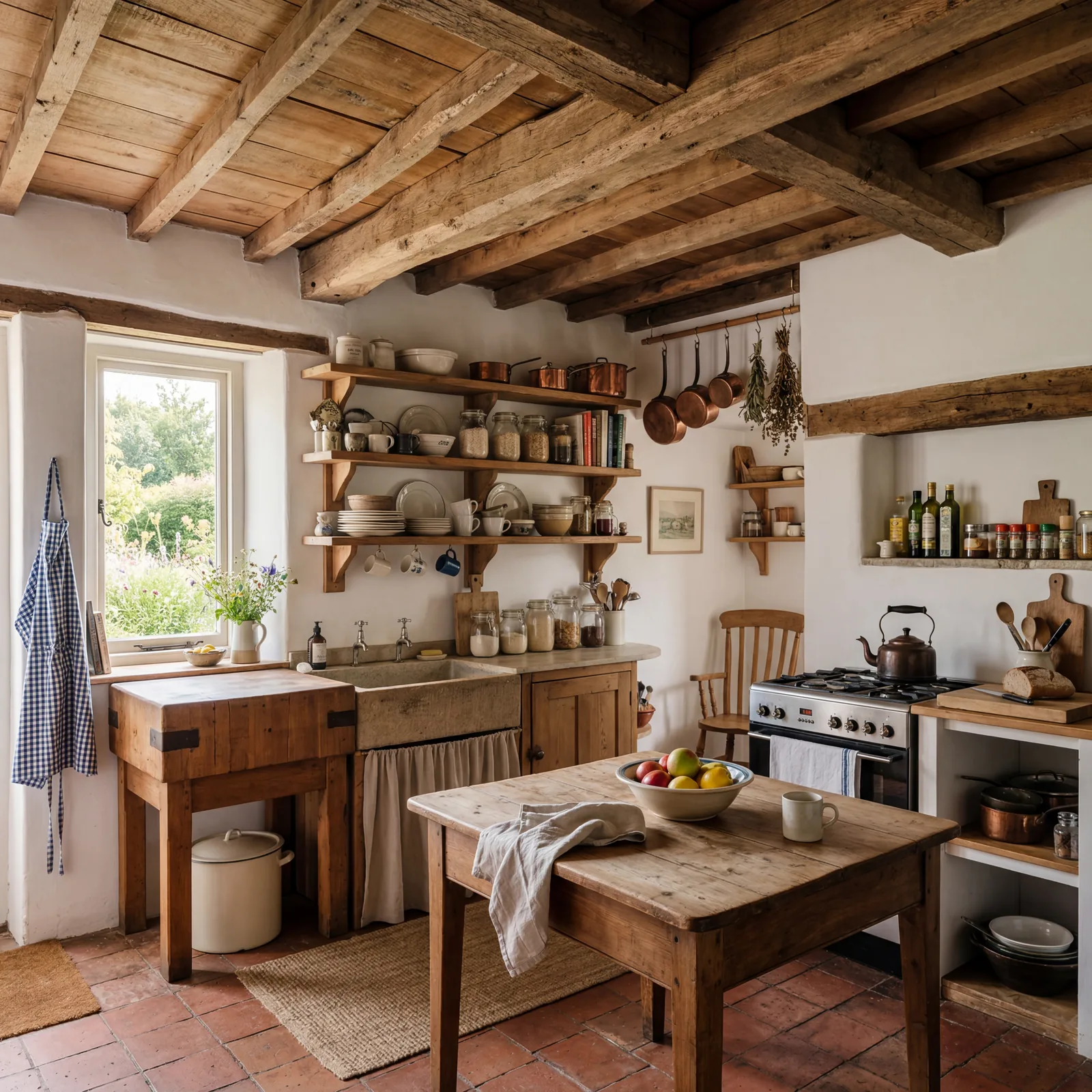
The ceiling of your kitchen is the one surface in the room that has never had to do any work.
Faux wood ceiling beams in stained pine or walnut finish — hollow polyurethane or real dimensional lumber — run along the ceiling and drop the visual weight of the room in the best possible way. They make the ceiling feel intentional rather than incidental.
Faux beam kits from RusticGrainWood on Etsy or Faux Wood Workshop run $80–$200 per beam, depending on length and profile. A standard kitchen with three beams across a 12-foot span typically costs $250–$600 total installed.
A ceiling that you notice is a ceiling that’s doing something for you.
The idea coming up next is the one that surprises everyone who tries it.
12. Apron-Front (Farmhouse) Sink
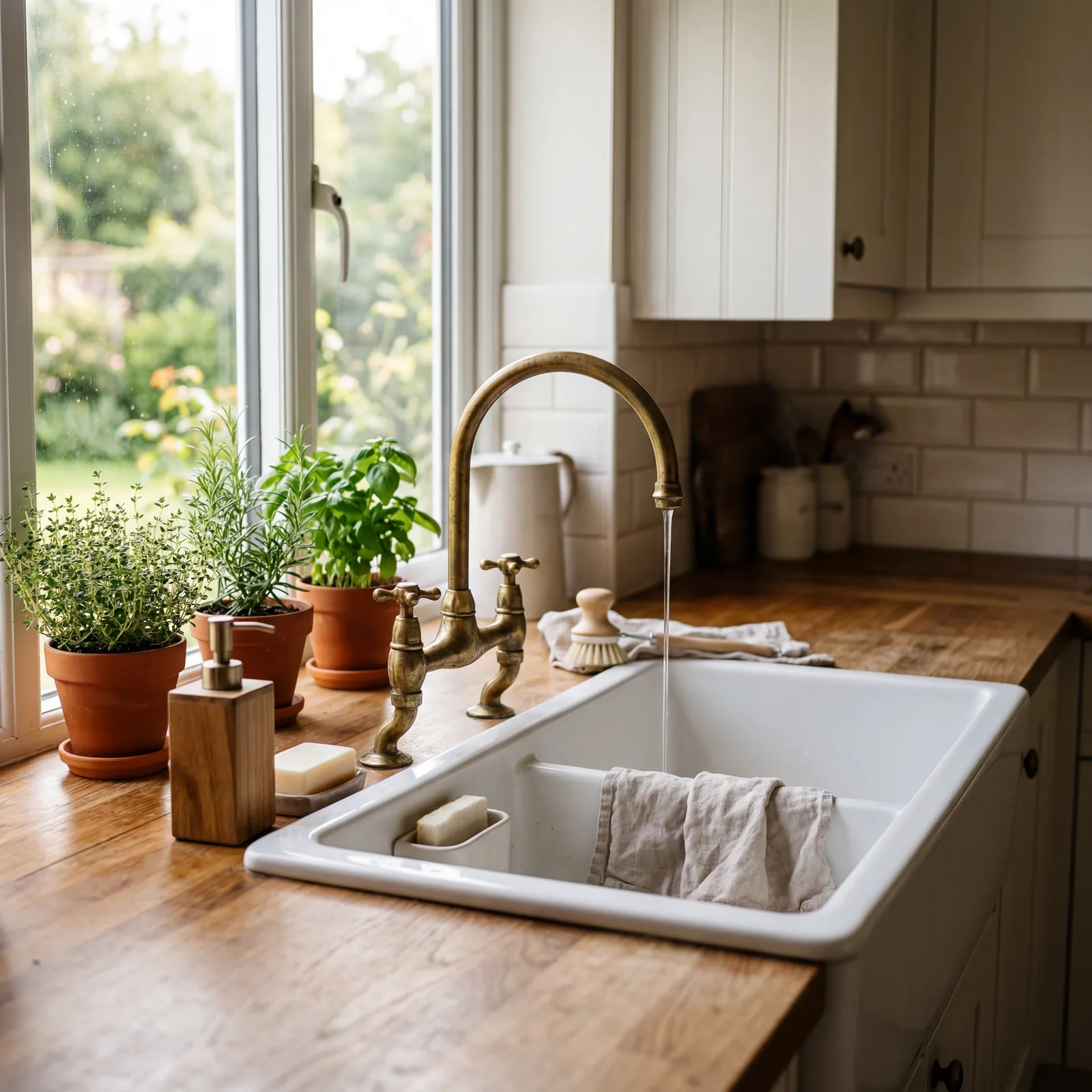
The moment you see an apron-front sink in a kitchen, you understand why every other sink looks like it’s making excuses.
A white fireclay or cast iron apron-front sink exposes the front face of the basin below the counter level, which gives it a visual weight and presence that a standard under-mount sink simply cannot match. It reads as an architectural element, not a fixture.
Kohler Whitehaven fireclay apron sinks run $800–$1,100, and installation requires a modified cabinet below. More affordable options from Lordear or Sinkology on Amazon come in at $350–$550.
The sink is where you stand more than anywhere else in your kitchen. It should be worth standing at.
11. A Bread Box and Ceramic Cookie Jar as Counter Decor
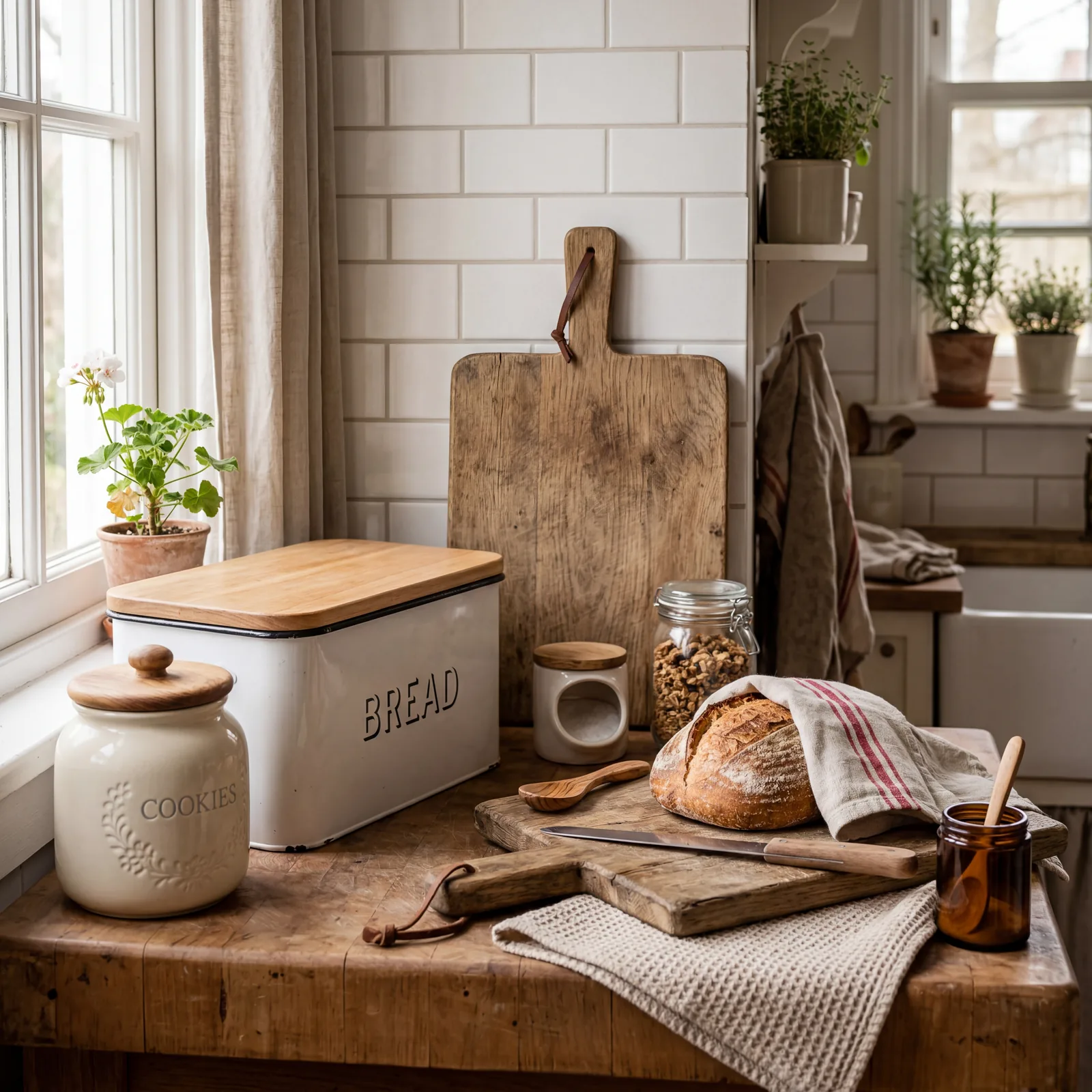
Counter decor in a farmhouse kitchen isn’t about styling. It’s about meaning.
A white enamel bread box and a ceramic cookie jar on the counter near the stove aren’t decorative objects — they’re functional ones that happen to look like they belong. The bread box keeps your sourdough fresh. The cookie jar is where the grandkids go first. Together, they communicate that this kitchen is used for actual living.
Vintage enamel bread boxes run $25–$45 on Etsy or Amazon. A simple Le Creuset or Emile Henry ceramic cookie jar runs $35–$65 and comes in a dozen colors that pair with farmhouse palettes.
Objects in a kitchen that have a job to do are always better than objects that are only there to be looked at.
10. A Chalkboard Wall or Chalkboard Panel for Recipes and Grocery Lists
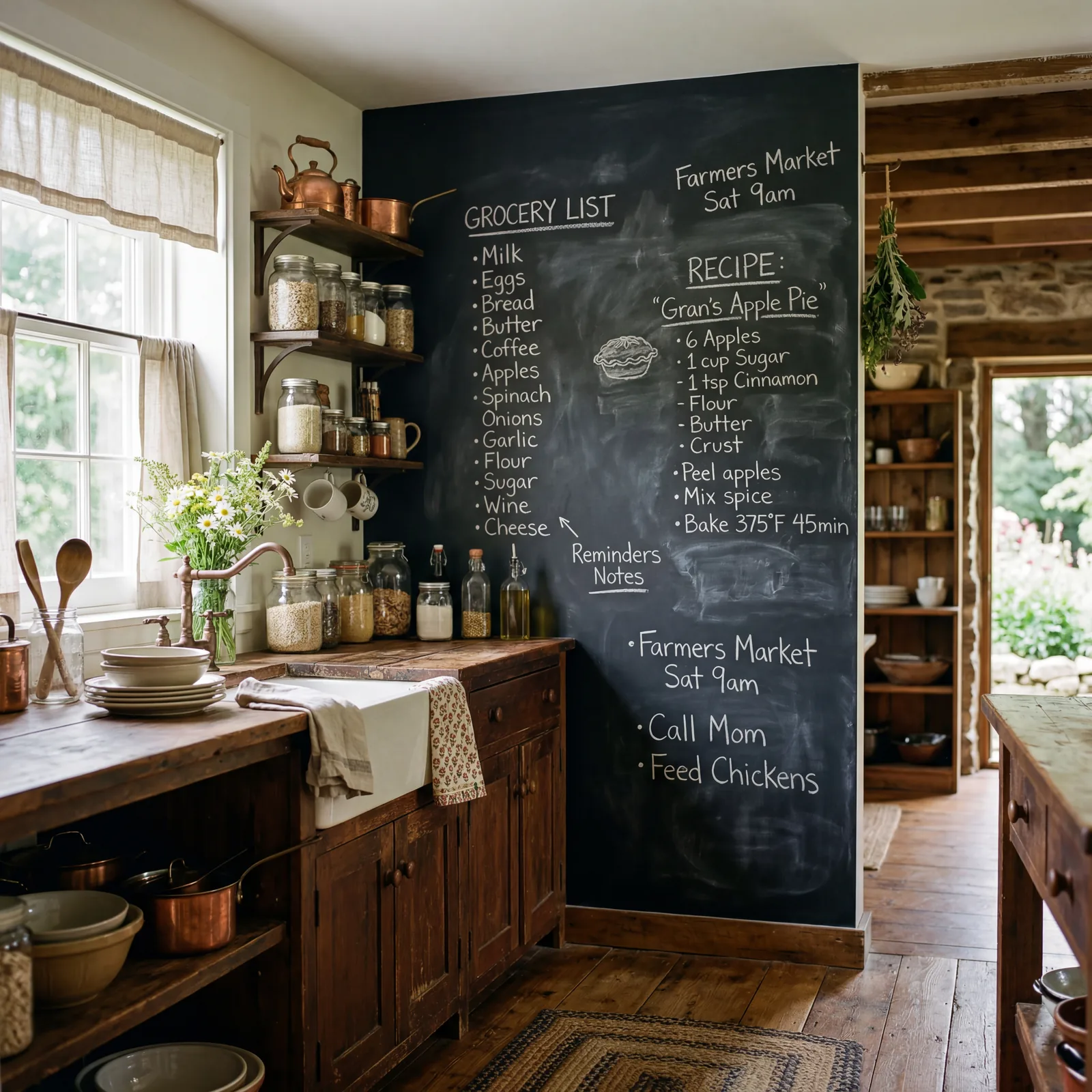
A chalkboard in a kitchen sounds like a Pinterest project from 2014. It’s not.
A full wall painted in Rust-Oleum Chalkboard Paint or a 4×8 framed chalkboard panel hung flush to the wall gives you a functional writing surface that also reads as an intentional design choice. Write the week’s menu, the grocery list, a note to whoever walks in last. The kitchen communicates that it’s the organizing center of the household, not just where dinner gets made.
Rust-Oleum Chalkboard Paint runs $15 for a quart, enough to cover a standard wall section. A framed chalkboard panel from Pottery Barn or Target runs $60–$120. Once conditioned with chalk, the surface lasts for years.
The kitchens that feel like the heart of the home are the ones where actual messages get left.
Next up is the idea that pays for itself within the first month of use.
9. Butcher Block Countertops (or a Butcher Block Section on the Island)
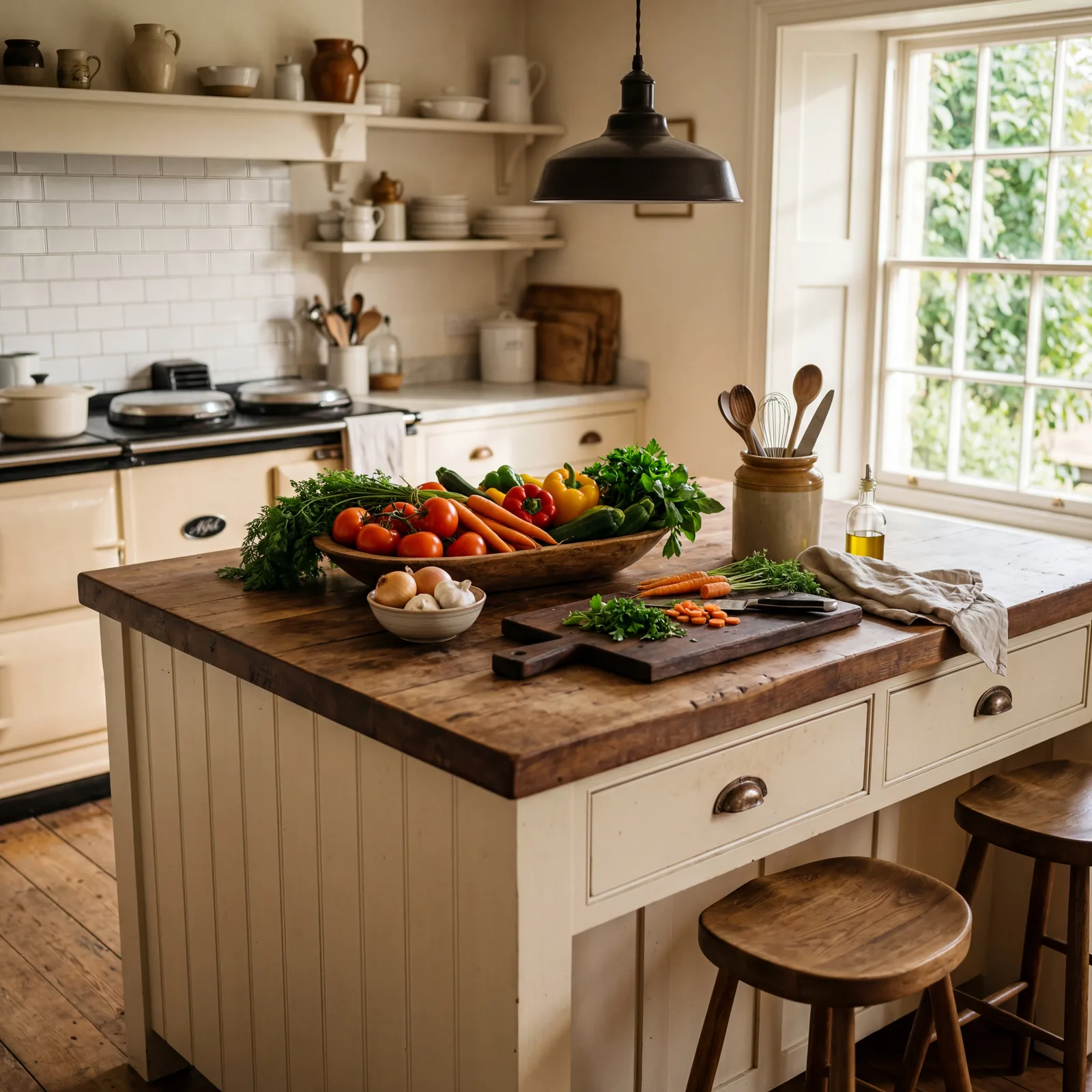
There’s a texture in a farmhouse kitchen that no quartz or granite can replicate: the warm, dense feel of real wood under your hands while you’re cooking.
Butcher block countertops in maple or walnut — either full counters or a section on the island — bring warmth, texture, and a sense of craft into the kitchen that stone cannot. They nick and mark over time, and every mark becomes part of the kitchen’s story.
IKEA’s NUMERÄR butcher block countertops run $150–$350 for a standard run, cut to size in-store. A solid walnut butcher block island top from Lumber Liquidators runs $200–$450. Seal with food-safe mineral oil every six months.
A counter you’ve put your hands on a thousand times is not just a surface. It’s the record of everything you’ve cooked there.
8. A Deep Drawer System for Pots, Pans, and Lids
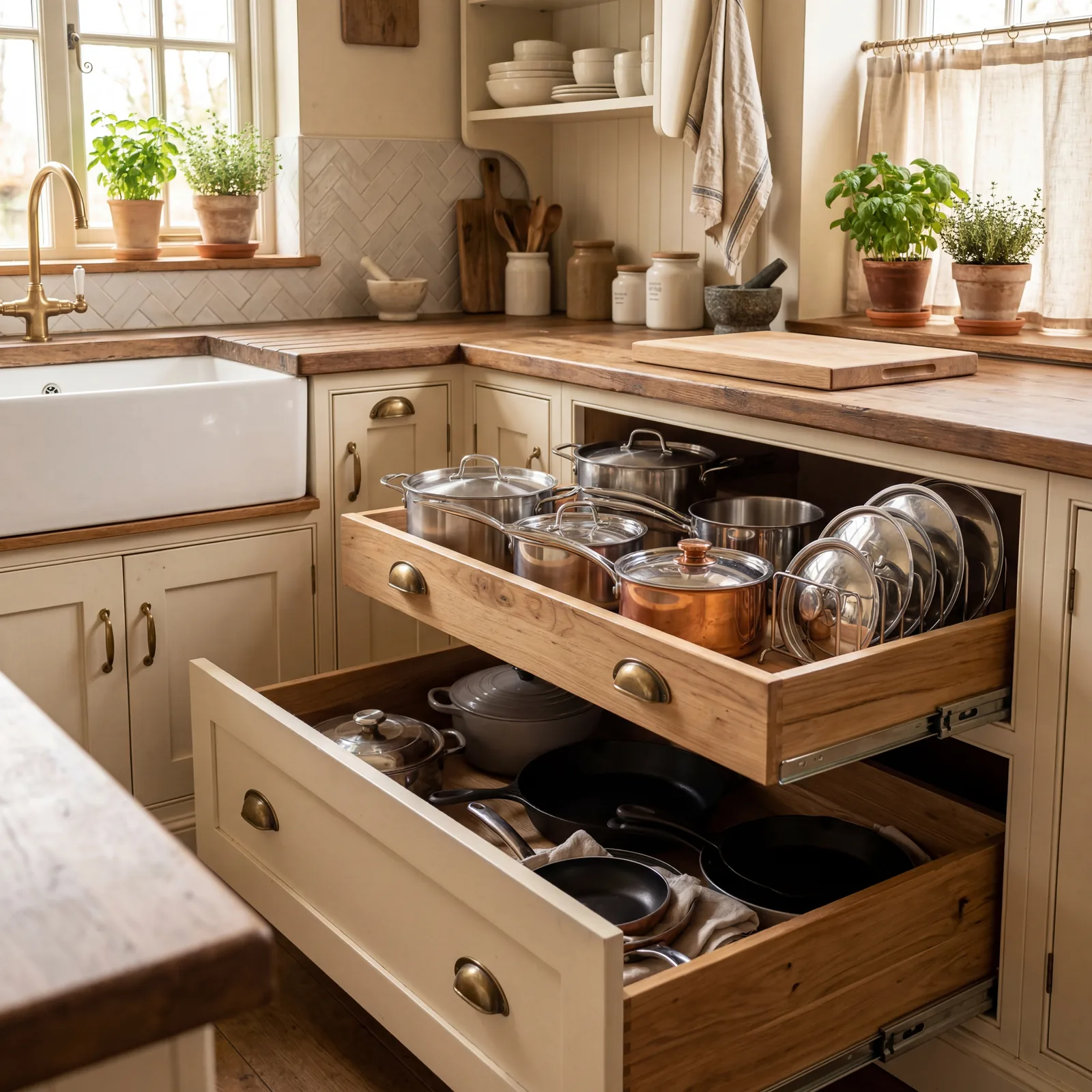
If you’ve been stacking pots inside pots and fishing lids out from behind each other for years, you know exactly what this one is about.
Deep pull-out drawer inserts installed in lower cabinets — or lower cabinets converted to full-extension deep drawers — put every pot and pan front and visible. You pull the drawer open, you see everything. No stacking, no excavation, no lid avalanche when you open the cabinet door.
Rev-A-Shelf deep pull-out organizers run $80–$140 and fit most standard 18-inch or 21-inch lower cabinet openings. A full cabinet-to-drawer conversion with IKEA SEKTION or custom cabinetry runs $300–$600 per cabinet.
Organization in a kitchen isn’t a preference. It’s the difference between cooking being a pleasure or a chore.
7. Stone or Shiplap Accent Wall Behind the Stove
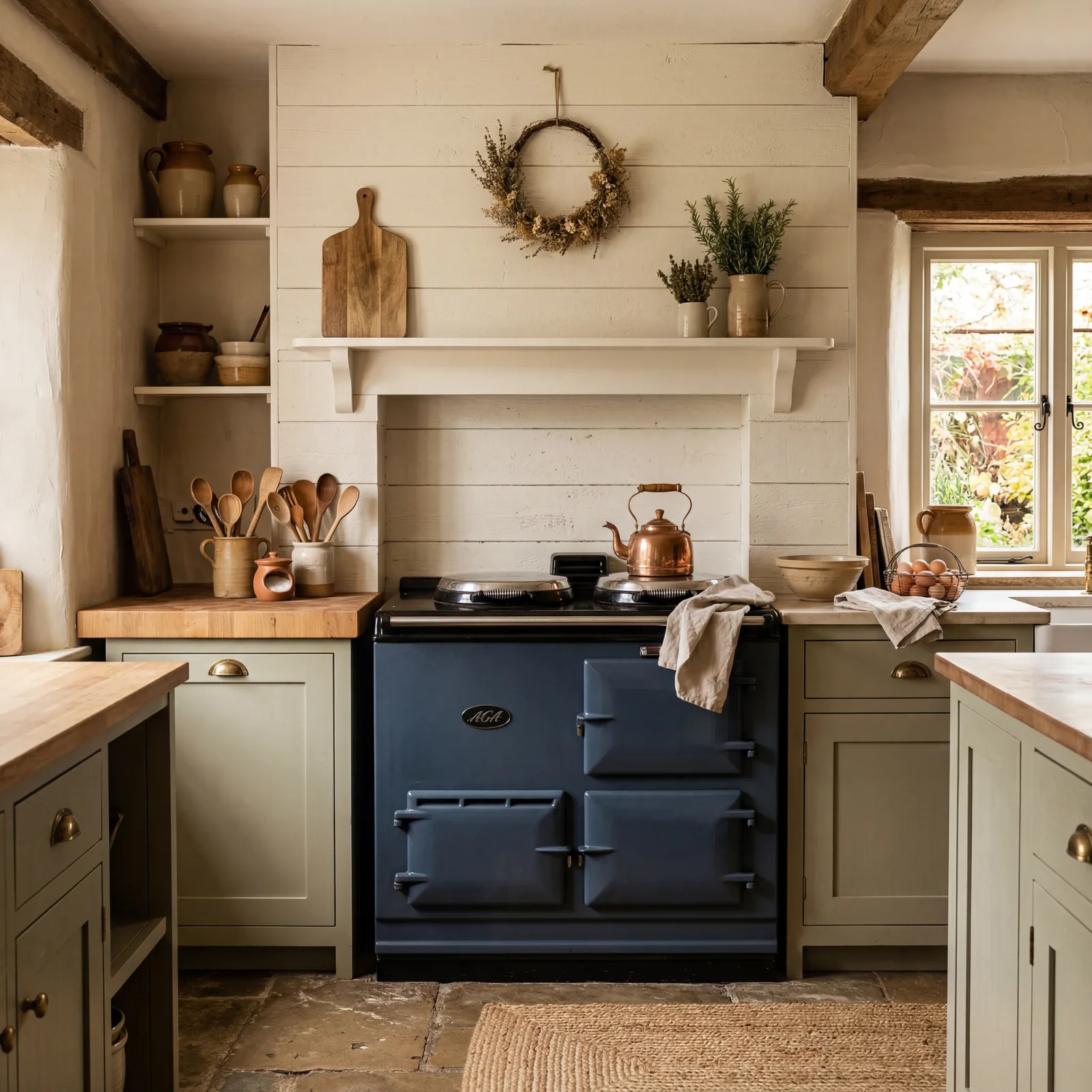
The wall behind your stove is the visual anchor of your entire kitchen, and right now it’s probably doing nothing interesting.
A shiplap accent wall in white or light grey paint behind the range creates an immediate focal point that pulls the whole room together. It brings texture and depth into a space that tile alone can’t match. Alternatively, stacked stone veneer panels give you the weight of a country kitchen without the structural work.
1×6 pine shiplap boards run $1.20–$2.50 per linear foot, and a standard behind-the-stove wall of 40 square feet costs $80–$150 in materials. Stone veneer panels run $6–$12 per square foot. Plan for one to two weekends with basic carpentry tools.
The wall behind the stove is the statement your kitchen makes when someone walks in the front door.
This next idea is the one interior designers are almost embarrassed by how simple it is.
6. Wicker or Woven Baskets for Pantry Storage on Open Shelves
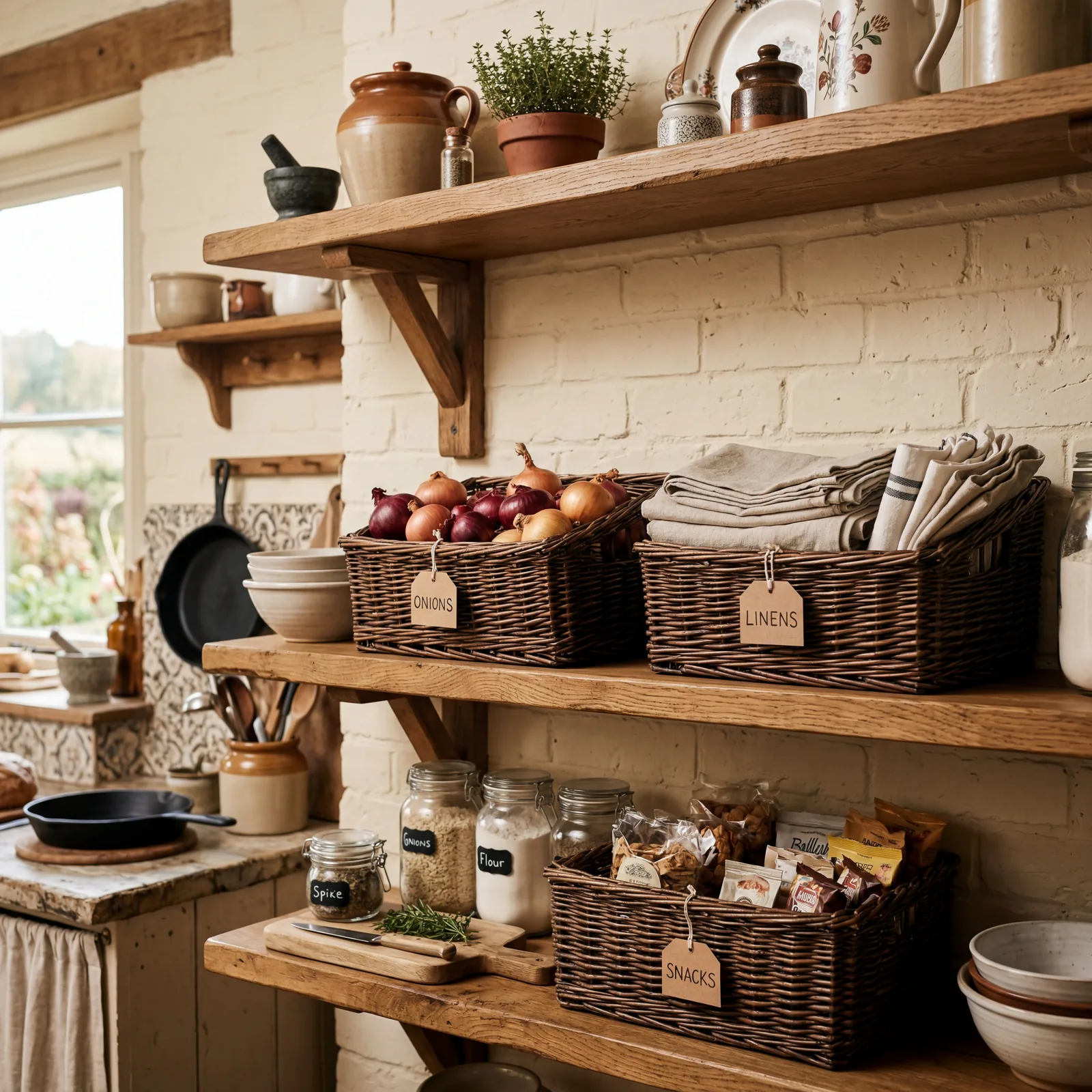
The wire bins and plastic containers on your pantry shelves are making your kitchen feel like a storage unit.
Natural wicker or seagrass baskets in two or three coordinating sizes on open shelves solve the problem of things that don’t photograph well — onions, snack bags, dishcloths — while adding the kind of organic texture that makes a farmhouse kitchen feel layered. Use a chalk label or a small tag on each.
A set of four wicker baskets in graduating sizes runs $28–$60 on Amazon or at World Market. Go for a single natural tone across all baskets — no mixing honey, dark, and light wicker on the same shelf.
A shelf that shows everything it holds honestly is more beautiful than one that hides everything behind closed doors.
5. A Built-In Bench or Banquette with Storage Underneath
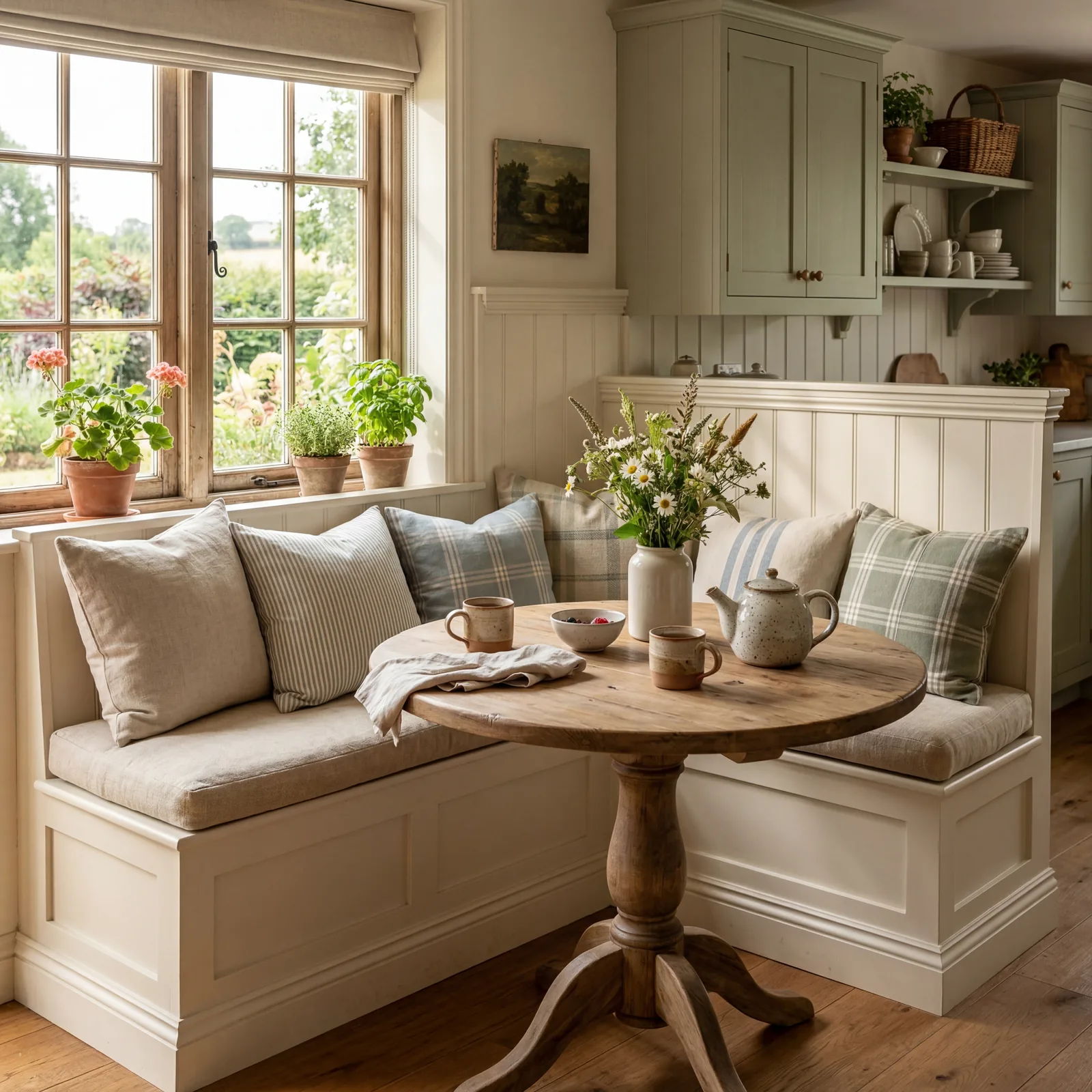
Every farmhouse kitchen that makes you stop and stare has somewhere to sit that isn’t a barstool.
A built-in bench or banquette against a corner wall or under a window creates the kind of kitchen seating that invites lingering. The cushion goes on top. The storage goes underneath — spare napkins, seasonal placemats, the bread-maker you only use at holidays. The bench does three jobs where a chair does one.
A custom-built banquette with storage from a local carpenter runs $600–$1,400, depending on size and finish. A DIY version using IKEA KALLAX shelving as the bench base runs $180–$280 in materials and a committed Saturday.
The kitchen that has somewhere comfortable to sit is the kitchen that becomes the center of the house.
4. All-White or Cream Painted Cabinets with a Dark Contrasting Island
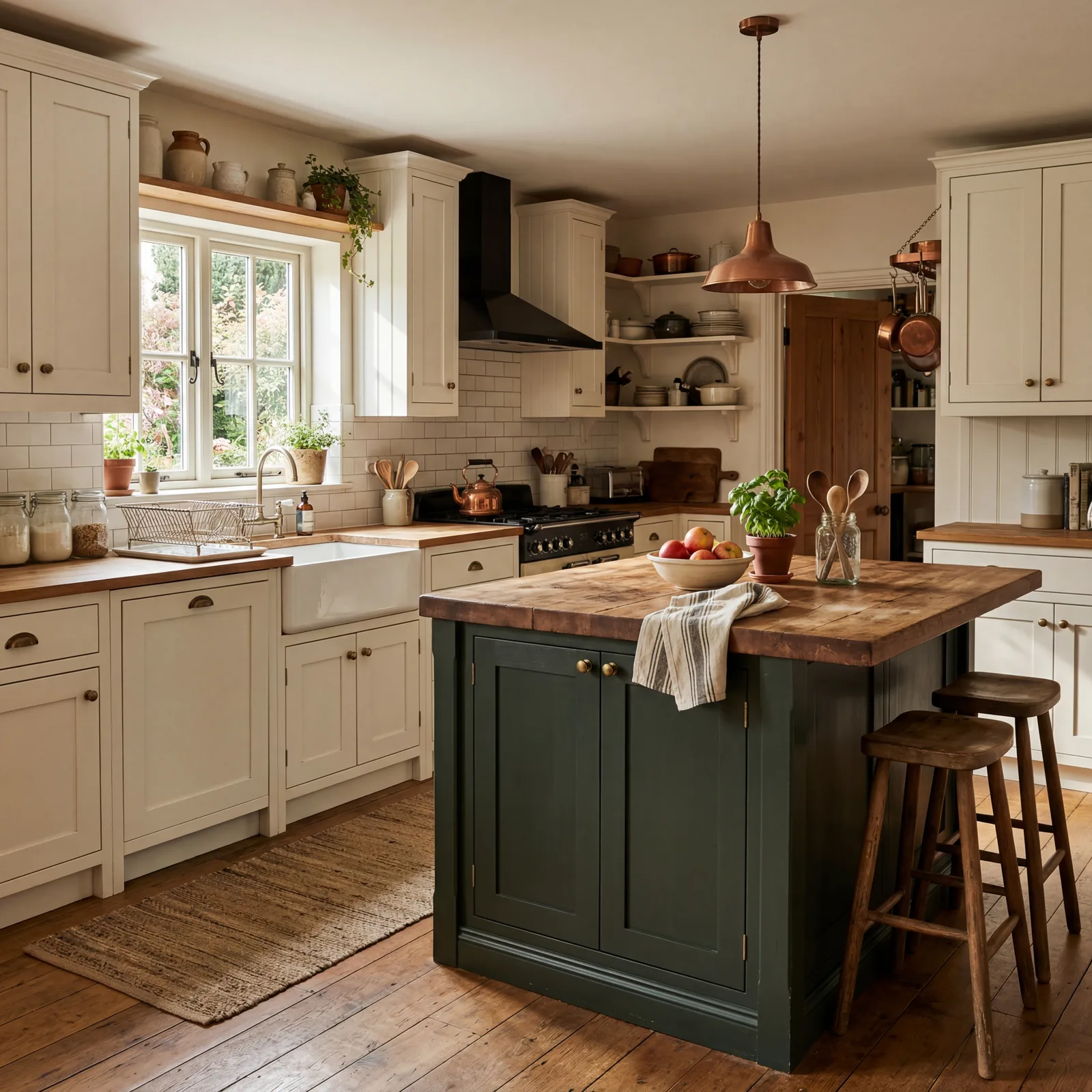
The combination that shows up in every farmhouse kitchen that people save and share is not a coincidence — it works because of contrast, and contrast is what your eye is looking for.
All-white or cream cabinets — Benjamin Moore White Dove or Sherwin-Williams Alabaster — paired with a dark contrasting island in forest green, charcoal, or navy gives the kitchen a visual hierarchy. The perimeter retreats. The island commands. Everything else lines up around that relationship.
A full cabinet repaint in professionally applied cabinet paint runs $1,200–$2,800 for a standard kitchen. DIY with Sherwin-Williams Emerald Urethane Trim Enamel and a quality foam roller runs $80–$120 in materials.
The kitchen that knows what it’s supposed to look at gives everyone who walks in the same feeling: this is deliberate.
3. Subway Tile Floor-to-Ceiling Backsplash Behind the Stove
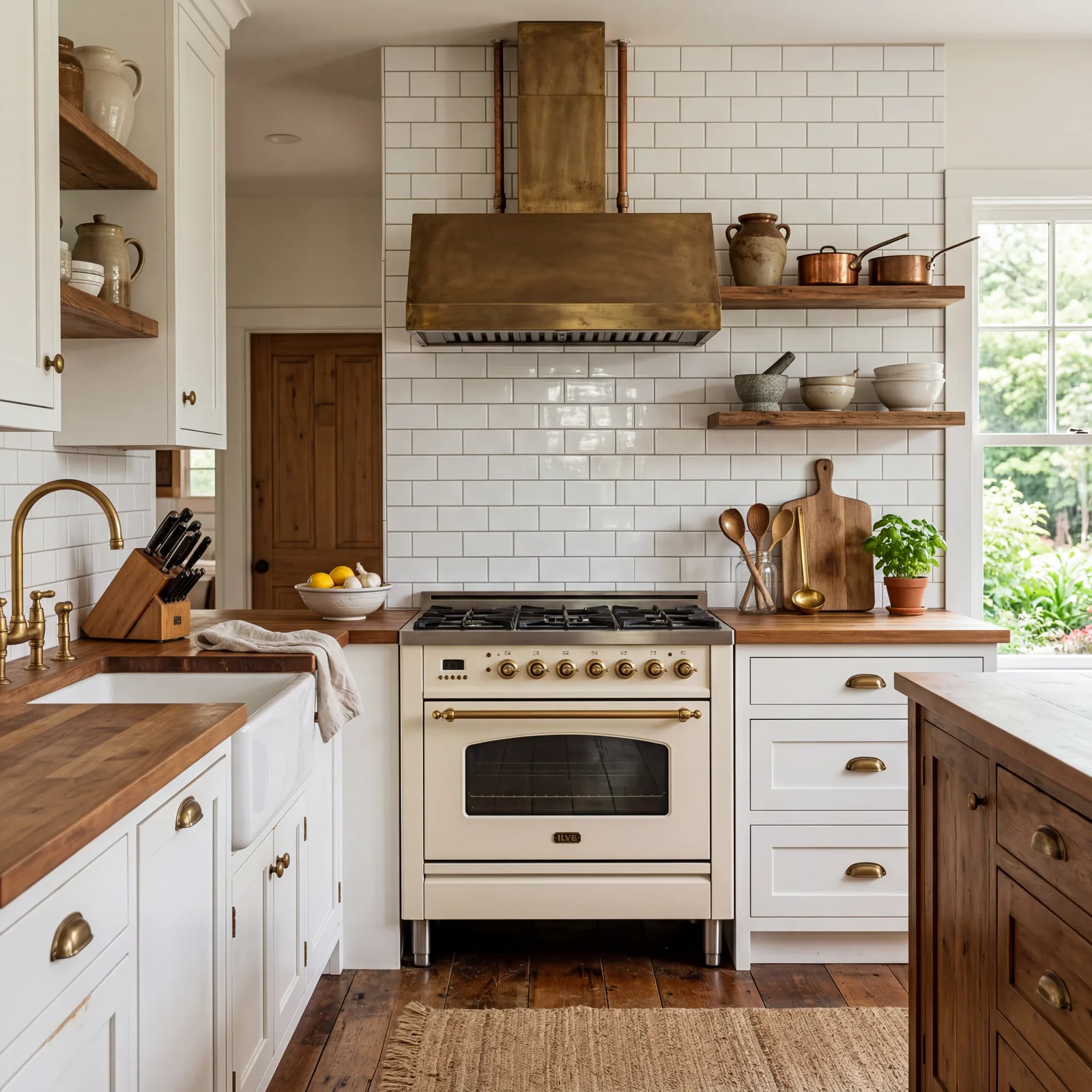
Standard backsplash goes from the counter to the bottom of the upper cabinets. That’s fine. Floor-to-ceiling tile behind the stove is something else entirely.
Running white subway tile from the countertop all the way to the ceiling in the cooking zone creates a statement that reads as both utilitarian and architectural. It’s what you see in old French brasseries and restored farmhouse kitchens in the Hudson Valley. The tile runs continuous and uninterrupted, and the room feels immediately more serious about cooking because of it.
Tile costs $1.50–$4 per square foot for standard subway. A floor-to-ceiling column of 9 feet by 4 feet is 36 square feet, costing $55–$145 in tile before grout and adhesive. The installation is a weekend job for anyone comfortable with tile work.
Going to the ceiling isn’t excessive. The standard height was just the safe choice that nobody thought to question.
2. An Apron Sink Paired with a Bridge Faucet in Unlacquered Brass
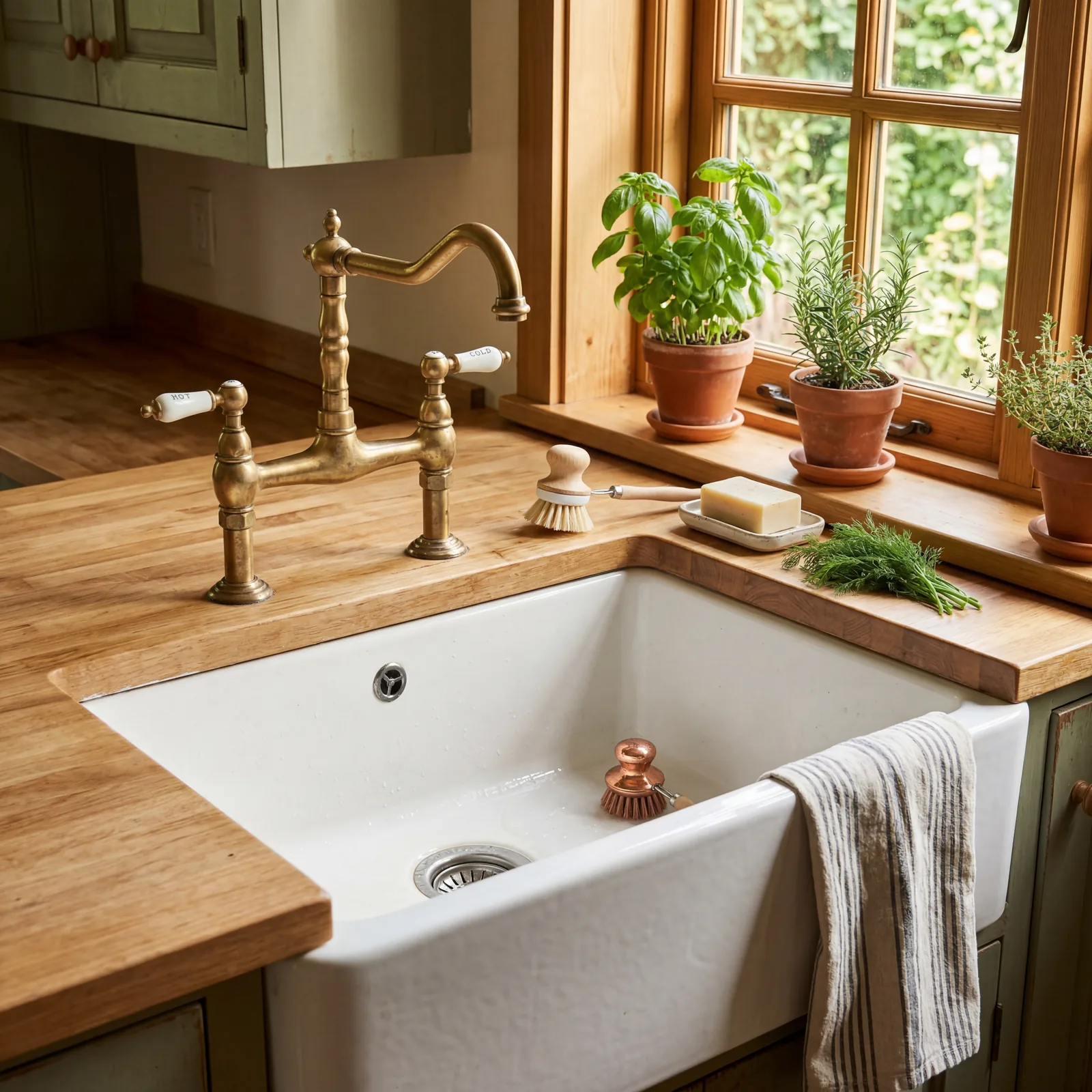
The apron sink alone is beautiful. The apron sink with a bridge faucet in unlacquered brass is a different category of beautiful.
A bridge faucet — where the hot and cold lines are bridged by a horizontal bar above the sink — reads as architectural. The unlacquered brass finish patinas over time, shifting from bright gold to warm amber in the areas you touch most. It’s a faucet that gets better the longer you use it, and no other finish behaves that way.
Rohl, Newport Brass, and Waterworks make bridge faucets in unlacquered brass in the $400–$900 range. More accessible options from Kingston Brass run $180–$280 and hold up well with regular use. Budget $150–$250 for a plumber to swap the faucet if you’re not comfortable with the connection.
A faucet you love using is not a luxury. It’s the reward for standing at the sink, which you do every single day of your life.
It’s bad. But it doesn’t come close to what’s waiting at #1.
1. A Farmhouse Breakfast Nook with a Built-In Bench and Table by the Window
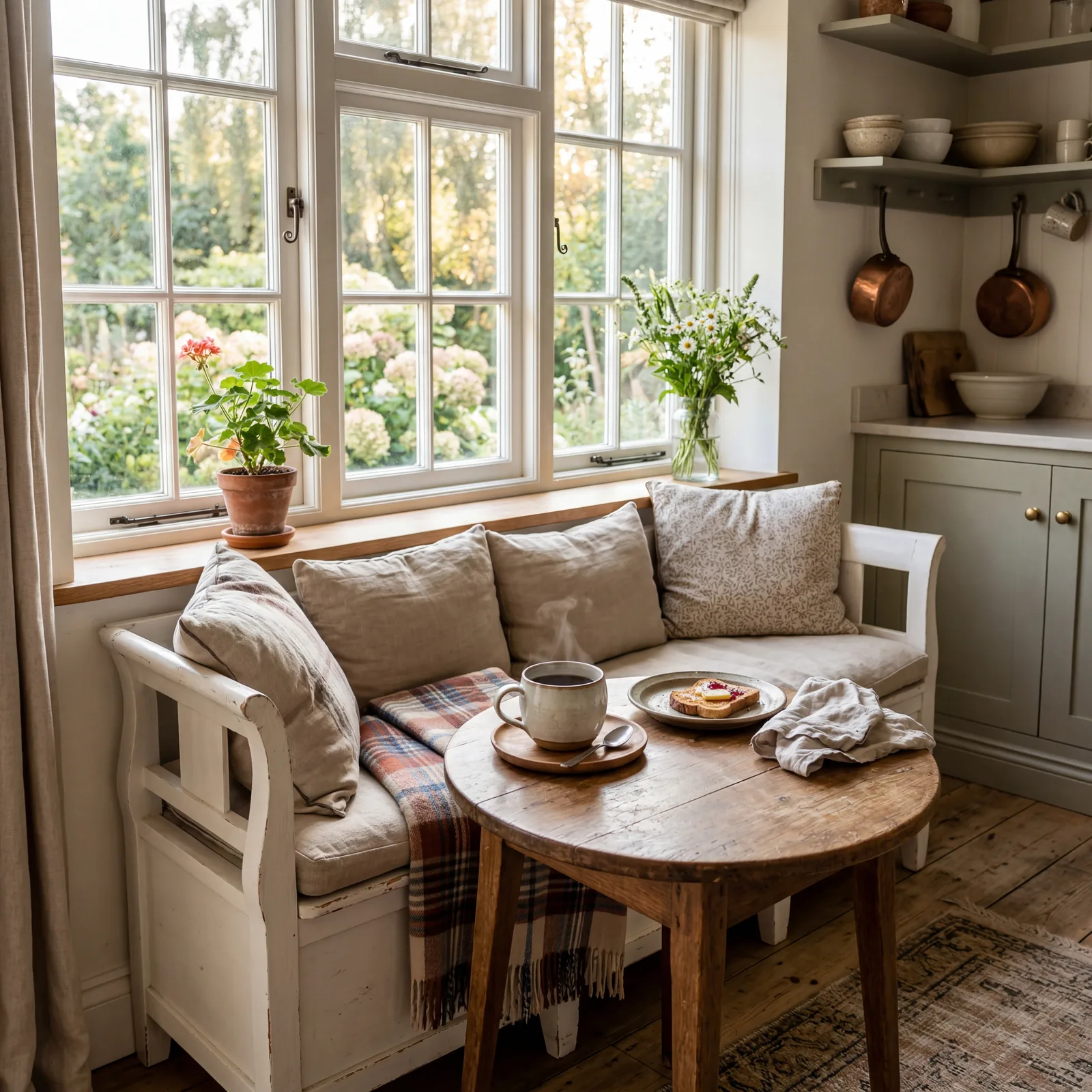
The One That Changes Everything
There is a reason every single “dream kitchen” image that stops your scroll has one of these in the corner.
A built-in breakfast nook — a window-facing bench with a small table, tucked into the corner where your kitchen meets the morning light — is not a design choice. It’s a declaration about what your kitchen is for.
A retired teacher from Tennessee named Carol told me she didn’t understand why her kids never stayed in the kitchen after dinner until her husband built a simple bench nook in the corner by the back window. “Now I have to kick them out,” she said. “The dog’s in there half the time too.”
The bench is painted white or cream to match the cabinets, with a 2-inch linen or canvas cushion in natural or ticking stripe. The table is small — 36 to 42 inches across, round or rectangular. The window above it faces east if you have the choice.
A custom-built breakfast nook with storage runs $800–$2,000 depending on your carpenter and your market. A DIY version using IKEA HEMNES cabinets as the base runs $350–$600 in materials.
But the real cost isn’t money. It’s deciding that your kitchen deserves a place to sit and watch the morning happen.
The kitchen that has a breakfast nook is the kitchen where the family ends up. Where the homework gets done. Where the coffee goes cold because the conversation went long.
Now look at your kitchen. There’s a good chance this one change alone would make you love the room again.
Worth Knowing Before You Redecorate
You don’t need to do all 26 of these — in fact, picking three or four from this list and doing them properly will do more for your kitchen than a rushed renovation that touches everything at once. Start with the one that keeps coming back to you after you’ve finished reading, because that’s the one your kitchen actually needs. If this list made you picture your kitchen differently, share it with someone who’s been saying they want to change theirs — you might just be the reason they finally do.