
Your grandparents didn’t call it survival. They called it Tuesday. Here are 42 things every 1930s family did without thinking twice.
42. Gathered Around the Radio Every Evening

The radio was the television, the internet, and the town square all in one wooden box.
Your grandparents sat in the same chairs every night at the same time. Missing a broadcast wasn’t really an option — there was no rewind, no catch-up, no second chance.
A family in rural Kansas might have been 40 miles from the nearest town. That radio was their only connection to the rest of the country.
Every family on the block had one. The ones who didn’t would knock on the door of a neighbour who did.
41. Darned Socks Instead of Throwing Them Away

A hole in a sock was a repair job, not a reason to go shopping.
Your grandmother kept a darning mushroom in her sewing basket. It was a smooth wooden tool you slipped inside the sock so you could weave new thread across the gap. The finished sock wasn’t perfect but it held another six months.
In 1932, a new pair of wool socks cost about 15 cents. When you’re feeding a family of five on $12 a week, 15 cents is a meal.
The skill is almost entirely gone now. Most people under 50 have never heard the word “darning.”
40. Made Dresses From Flour Sacks

Flour came in cotton sacks with printed patterns. That wasn’t an accident.
Flour mills started printing their sacks with cheerful fabric designs in the late 1920s and early 1930s because they knew mothers were sewing them into clothes. Girls went to school in dresses made from the same sacks that had held the family’s bread flour two weeks earlier.
Some families chose their flour brand specifically based on which sack pattern they liked best.
Your grandmother’s “favourite dress” from childhood was probably made from a feed sack. She never told you because it wasn’t something you mentioned.
The next one happened in every home, every single morning.
39. Kept a Kitchen Garden

Every family with a scrap of land grew food. Not as a hobby. As a strategy.
Tomatoes, beans, corn, potatoes, onions. Whatever the soil would take. The garden ran from early spring to late fall and what it produced was the difference between eating well and scraping by.
The USDA estimated that by 1934, over 18 million American families maintained a kitchen garden. That number didn’t include apartment-dwellers with window boxes.
A garden you planted in April paid out in August. It was the closest thing to free food the 1930s had.
38. Canned Vegetables Every Summer

Late summer meant weeks of canning. Every jar was a meal that would last through January.
Your grandmother stood over a boiling pot for hours, sterilising jars, packing in tomatoes or green beans or peaches, sealing each lid with a rubber ring. By the time the first frost came, the cellar shelves were full.
A good canning season could put up 200 to 400 jars for a family of five. That’s the difference between a hard winter and a hungry one.
You heard the seal pop when you opened a jar the following February. That sound meant she’d done it right.
37. Saved Every Scrap of Fat for Cooking

Nothing from the pan went to waste. Every drop of bacon fat, chicken drippings, and beef lard was saved.
There was a can next to the stove. Every time you cooked meat, the drippings went into that can. It sat at room temperature without going rancid because rendered animal fat keeps for months if you’re careful about it.
That fat was the cooking oil, the butter substitute, the pastry shortening, and the flavour base for half the week’s meals.
Throwing it away would have been almost unthinkable. Some families didn’t throw it away for years.
Your grandparents would recognise this immediately.
36. Traded With Neighbours Instead of Shopping

Cash was short. Goods weren’t always scarce. Swapping was the obvious solution.
Your grandmother might trade a dozen eggs for a quart of milk. A neighbour who grew extra zucchini would swap it for someone else’s surplus beans. A woman who sewed well might make a dress in exchange for a side of pork.
This wasn’t barter in the formal sense. It was just how neighbourhoods functioned when most people had more time and produce than they had money.
The trust required to live this way was enormous. It was also completely ordinary.
35. Sent Children to Fetch Water

Running water was not guaranteed. In rural areas in the 1930s, it was often a pump in the yard or a well down the road.
Children were sent to fetch water before school, after school, and whenever the household needed it. You carried two buckets at a time if you were old enough, one in each hand for balance.
In 1930, only about 30% of rural American homes had indoor plumbing. That number dropped further in the poorest counties.
Carrying water was morning chores. Your grandparent who grew up in a rural home did this before breakfast, every day.
34. Patched Clothing Until It Couldn’t Be Patched Anymore

When something wore through, you didn’t replace it. You patched it.
A shirt with a torn elbow got a patch cut from another worn-out shirt. Trousers with frayed knees got squares of matching fabric sewn over them. Children’s clothes got passed down three or four siblings deep, with patches on the patches.
Mothers were expected to keep a family looking presentable no matter how little they had to work with. A well-patched shirt was a point of quiet pride.
When the patching finally gave out, the fabric became rags. Nothing was thrown away before it had lived three or four lives.
Most people under 50 have never heard of this.
33. Woke Before Dawn on Farms

Farm children didn’t sleep in. The animals didn’t wait.
Chickens needed feeding, cows needed milking, horses needed watering and harnessing before school. All of it happened between 4 and 6 AM before the school bell, if there was school at all during planting or harvest.
During the Dust Bowl years of the mid-1930s, farm families across the Great Plains worked harder in a collapsing landscape than most people today work in their entire careers.
Your grandparent who grew up on a farm was hardened in ways that didn’t show on the outside.
32. Made Their Own Soap

Soap wasn’t bought. It was made from wood ash and rendered fat, two things most families had in surplus.
The process involved leaching water through ash to make lye, then combining the lye with saved fat over a slow fire. The result was a soft, greasy soap that did the job even if it didn’t smell like lavender.
Bought soap existed and cost about 5 cents a bar. When 5 cents represents real sacrifice, you make your own.
This skill was passed down from grandmother to mother to daughter for generations. Most families stopped making soap the moment they could afford not to.
31. Kept Chickens in the Backyard

Chickens were livestock. Even in towns.
A small flock of hens meant eggs every morning without spending a penny. A hen past her laying years became Sunday dinner. The droppings went into the garden. Every part of the chicken contributed something.
City ordinances banning backyard chickens largely didn’t exist until after World War II. Before that, a coop in the backyard was perfectly normal in most American towns.
Your grandparents in a town house could have had chickens. Many of them did.
The next one happened in every single kitchen, every single day.
30. Used Every Part of the Animal

When a family butchered a pig or a chicken, nothing went in the garbage.
Organ meats were eaten first, before they could spoil. Bones went into a pot for broth. Fat was rendered. Skin was fried or used to season cast iron. The feet went into soup. Even the blood, in some traditions, was used for sausage or pudding.
“Nose to tail” eating is trendy in upscale restaurants now. In 1933, it was just called eating.
Families who wasted meat were families who ran out of food before the month ended.
29. Walked Miles to School

There was no school bus for many rural children in the 1930s. You walked.
Two miles each way was ordinary. Five miles wasn’t unusual in sparsely populated counties. Children walked through mud, snow, and heat without question because that was simply how you got to school.
In some areas, older children were pulled out of school entirely during planting season. Their labour was more valuable in the field than their education was in the classroom.
Your grandparent who mentioned walking to school wasn’t exaggerating. They really walked, every day, in whatever the weather threw at them.
28. Repaired Shoes With Cardboard

When the sole of a shoe wore through, you cut a piece of cardboard to fit inside.
It didn’t fix the shoe. It just kept your sock from touching the ground while you saved up for a repair or a new pair. Children went through cardboard inserts constantly, replacing them when rain soaked them through.
A professional shoe repair in 1933 cost about 15 to 25 cents for half-soles. That was real money. Many families put it off for months.
If your grandparent ever mentioned “holes in their shoes,” this is what they meant. Literally.
Your grandparents would recognise this immediately.
27. Listened to FDR’s Fireside Chats

When Franklin Roosevelt came on the radio, families stopped what they were doing.
FDR’s fireside chats began in 1933 and continued through the Depression. He spoke directly to Americans in plain language, explaining the banking crisis, the New Deal, the state of the country. People trusted the voice coming out of that radio in a way that’s hard to replicate today.
An estimated 60 million Americans listened to his first chat in March 1933. That was roughly half the country’s population.
Your grandparents didn’t just hear news. They heard the President talking to them, personally. That mattered.
26. Made Bread From Scratch Every Week

Store-bought bread was a luxury many families cut first when money got tight.
Your grandmother baked bread every week, sometimes twice a week. It meant buying flour in bulk, keeping yeast alive, and spending an afternoon kneading and waiting through the rise. The smell filled the house for hours.
Flour sold for about $1.25 for a 25-pound sack in 1933. A family that baked their own bread could feed themselves for a fraction of what bakery bread would have cost.
Homemade bread with butter, if you had butter, was also just one of the best things you could eat.
25. Kept a Strict Weekly Schedule

Monday was washing. Tuesday was ironing. Wednesday was mending. Every week, without variation.
This wasn’t personal preference. It was a system that made a household run without store-bought conveniences. Everything had a day because everything took real time and physical effort.
Washing clothes by hand took hours. Ironing with a cast iron heated on a stove took hours more. If you let it slip, it piled up and consumed the whole week.
Your grandmother’s week was mapped out before it started. The structure wasn’t rigid. It was survival.
Most people under 50 have never heard of this.
24. Grew Victory Gardens

The victory garden idea predated World War II. It started with home food production in the early Depression.
Families planted every available patch of land, front yard, side yard, empty lots. It was part necessity and part civic identity. A family that grew its own food freed up commercial supply for those who couldn’t.
The USDA actively promoted backyard gardening throughout the 1930s with pamphlets and extension agents.
Every family on the block had a garden. The ones that didn’t were the ones that couldn’t. Nobody judged either way.
23. Heated One Room and Stayed in It

In winter, you didn’t heat the whole house. You heated one room and everyone went there.
Fuel cost money. Whether it was coal, wood, or kerosene, you burned what you needed and not a cubic foot more. The living room or kitchen, wherever the stove was, became the family gathering point from October to March by necessity.
Bedrooms were cold. You undressed fast and piled on blankets. The warmth from five bodies in a small bed was itself a heating strategy.
Wasted heat was wasted money. Your grandparents didn’t waste money.
22. Kept a Ration Book

Rationing didn’t start with World War II. Informal food rationing at the household level was standard in the Depression.
Mothers tracked what came in and what went out. Sugar, coffee, butter, and meat were stretched as far as they’d go. A family might allow itself one piece of fruit per child per week. One piece of candy. One cup of coffee per adult per day.
The discipline required to live this way is almost incomprehensible to someone who grew up with unlimited shelf space.
Your grandmother knew exactly what was in every cabinet. She had to.
The next one happened in every home, every night.
21. Went to Bed When It Got Dark

Electricity cost money. In rural areas, it often wasn’t available at all.
Families rose with the sun and went to bed when it set, or close to it. Oil lamps and candles were used sparingly. Staying up late to read by lamplight was a small luxury most people couldn’t justify regularly.
In 1930, only 13% of American farms had electricity. That number climbed slowly through the decade as the Rural Electrification Administration extended power lines into the countryside.
Sleep wasn’t a lifestyle choice in the 1930s. It was just what happened when the light ran out.
20. Kept Furniture for Generations

Furniture wasn’t replaced. It was repaired, repainted, and passed down.
A wooden table that wobbled got a new leg. A chair with a cracked seat got a replaced slat. Upholstery wore out and got re-covered with whatever fabric was available. The same sofa might serve three families across thirty years.
The concept of furniture as a disposable item didn’t exist in the 1930s. A table was a significant purchase you expected to outlive you.
Some of those pieces are still in American homes today. Your grandparents’ dining set might be the best-built piece of furniture you’ll ever own.
19. Saved String, Rubber Bands, and Wrapping Paper

Nothing useful was thrown away. Not string, not rubber bands, not the paper a package came wrapped in.
Twine was saved and balled up for reuse. Wrapping paper was smoothed out and folded for the next gift. Rubber bands, when they existed, lasted for years. Buttons were cut from worn-out shirts before the fabric was turned into rags.
This habit was so ingrained that many Depression-era families kept it for the rest of their lives. Your grandmother who saved every twist-tie and rubber band didn’t do it because she was eccentric.
She did it because her hands remembered a time when losing one actually mattered.
Your grandparents would recognise this immediately.
18. Washed and Reused Wax Paper

Wax paper was the plastic wrap of the 1930s. It was also expensive enough to wash and reuse.
After wrapping a sandwich or covering a bowl, you rinsed it, dried it flat, and put it back in the drawer. A single sheet might last a week. The waxed surface resisted water enough that this actually worked.
This sounds extreme from a 2020s perspective. From a 1933 perspective, it was obvious common sense.
The habit of washing and saving disposable packaging lasted in many families well into the 1970s. The Depression left a mark that didn’t fade when the economy improved.
17. Shared Bathwater

Heating water took time and fuel. You didn’t heat a fresh tub for every person.
One tub was filled and the family bathed in order, usually from oldest to youngest or by who was dirtiest. The same water served the whole family. By the last child, the water was cold and grey.
This wasn’t considered unusual. It was just how bath night worked.
The phrase “don’t throw the baby out with the bathwater” is an old one. In the 1930s, it was still a practical warning, not just a figure of speech.
16. Made Clothes Last With a Treadle Sewing Machine

Every household with a sewing machine used it constantly. It wasn’t a hobby. It was how clothes stayed wearable.
A treadle machine ran without electricity, powered by the rhythmic foot pedal motion. Your grandmother could hem a skirt, patch a seam, or let out a waistband while children played at her feet.
Singer sold over 3 million sewing machines in the early 1930s despite the Depression. Families found the money because the alternative, buying clothes they couldn’t afford, was worse.
The machine that sits in an antique shop now was probably the centre of a household’s clothing strategy for twenty years.
The next one catches people off guard.
15. Kept a Root Cellar

Before refrigerators, you kept food cold the way the earth keeps it cold.
A root cellar was a hole in the ground, under the house or dug into a hillside, where the temperature stayed at 35 to 40 degrees year-round. Potatoes, carrots, turnips, beets, and apples could last all winter down there. Canned goods lined the walls on wooden shelves.
In rural areas, the root cellar was as important as the kitchen. Lose the harvest and you ate from those shelves. Lose the cellar and you faced winter without reserves.
Some families still have root cellars today. Most of them were dug by a grandfather who understood exactly why they mattered.
14. Ate the Same Cheap Meals Repeatedly

Beans and cornbread. Salt pork and cabbage. Fried potatoes with onions. The Depression menu was short.
These meals rotated through the week because they were cheap, filling, and could be made in bulk. A pot of beans cost pennies and fed a family for two days. Cornbread added calories without adding cost.
Poverty in the 1930s meant eating the same five meals on rotation for months or years at a time. Variety was what you had in better years. In 1933, you ate what kept everyone standing.
Children who grew up eating beans and cornbread every other day are the same grandparents who couldn’t throw away leftovers fifty years later. It made a mark.
13. Reused Tea Bags and Coffee Grounds

Coffee and tea were luxuries in the Depression. You got every last use out of them.
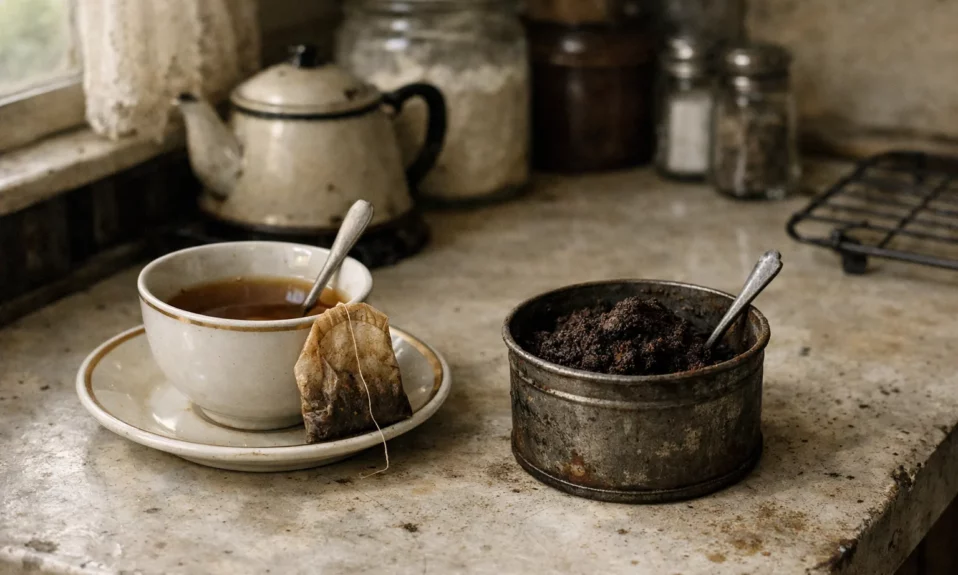
A tea bag went into the pot once, dried on a saucer, and went in a second time for a weaker cup. Coffee grounds were used twice before they were composted into the garden. Chicory was added to stretch coffee further, and in the hardest years, it replaced the coffee entirely.
A pound of coffee in 1933 cost about 26 cents. That doesn’t sound like much until you know that a full day’s labour on a farm sometimes paid 50 cents.
Half a day’s work for a pound of coffee. You didn’t throw away the second use.
Most people under 50 have never heard of this.
12. Kept Receipts in a Household Account Book

Your grandmother tracked every penny that came in and went out. Not in an app. In a lined notebook with a pencil.
Every grocery purchase, every utility payment, every small coin spent at the general store. The account book was reviewed weekly, usually Sunday after church. If the numbers didn’t add up, you figured out why before Monday.
Women managed the household accounts in most Depression-era families because they were the ones making the purchasing decisions. They knew the budget in detail, to the cent.
The discipline was absolute. A family that lost track of spending ran out of money before the month ended.
11. Repurposed Everything That Broke

When something broke, the question wasn’t “where do I buy a new one?” It was “what can this become?”
A cracked crock became a planter. A worn-out boot became a boot scraper or a toy. Broken handles were used as kindling. Old newspapers were twisted into fire starters. Tin cans became measuring cups, pencil holders, or small pots for seedlings.
The creativity involved in Depression-era repurposing was real and constant. It wasn’t Pinterest. It was necessity with imagination added.
A family that could see a second use for everything it owned stretched its resources further than a family that couldn’t.
10. Took Only What the Church Allowed

The church wasn’t just spiritual in the 1930s. It was social infrastructure.
Food banks didn’t exist in their modern form. The church ran the charity. Families in need applied through the deacon or the pastor, who knew everyone in the congregation personally. Help was given, but it came with awareness. The community knew who was struggling.
This created a complicated dynamic. Accepting help meant exposing need to people you sat beside every Sunday. Many families went without rather than ask.
Pride was the luxury that cost the most in the 1930s.
The next one happened in every home, every night.
9. Mended by Lamplight After the Children Were in Bed

The children went to bed. The mending came out.
After the dishes and the evening radio broadcast, your grandmother sat with the lamplight and worked through the week’s damaged clothes. It was the only time in the day that was quiet. Some women did it for hours.
It wasn’t called self-care. It was just the work that had to be done and couldn’t be done while children needed attention.
A woman who raised four children through the Depression averaged, by some estimates, over 400 hours of mending per year. That’s ten full work weeks of just repairing clothing.
She didn’t mention it because it was just part of the week.
8. Made Lye Soap for Laundry

Laundry soap for a full family’s clothes was too expensive to buy every week. So you made it.
The same basic lye soap that cleaned dishes and hands went to scrubbing clothes against a washboard in a metal washtub. It was hard on the hands and took real muscle. Laundry day left you tired in a way that didn’t wash off until the next morning.
Washing machines existed by the 1930s but cost around $60 to $80, roughly two months of a working man’s wages. Most families couldn’t touch that price.
Your grandmother’s hands looked the way they did because of this, among other things.
7. Entertained Themselves Without Spending a Penny

Movies cost a dime. When a dime is dinner, you don’t go to the movies.
Entertainment in the 1930s was what you made at home. Card games, board games, storytelling, singing around the piano if you had one. Neighbourhood children played outside from morning until dark without supervision because that’s what children did.
Community dances, church socials, and neighbourhood baseball games were the social calendar. All of them were free or nearly free.
The Depression generation didn’t confuse entertainment with spending. They knew how to have a good time on nothing. Most of their grandchildren don’t.
Your grandparents would recognise this immediately.
6. Hung Laundry on a Line to Dry

The clothesline was how you dried everything. Always. Without exception.
Sheets, shirts, trousers, socks, dresses, undergarments. Everything went on the line. In summer, it took an afternoon. In winter, clothes sometimes froze stiff on the line and had to be brought in to finish thawing and drying by the stove.
You learned to read the weather before hanging laundry. You watched the clouds. A sudden afternoon storm could ruin hours of work and leave you with clothes to rewash.
The smell of line-dried sheets is something you remember if you grew up with it. Most people over 70 would still recognise it instantly.
5. Wrote Letters Instead of Making Calls

Long-distance phone calls were expensive enough to be considered an event. Letters were how families stayed in contact across distances.
Your grandparents wrote every week or every few weeks to parents, siblings, and cousins who’d moved away during the migration years of the 1920s and 30s. The letters were long, detailed, and written with care because they were the only thread connecting people who might not see each other for years.
A long-distance call from New York to Chicago in 1933 cost about $4 for three minutes. That was a week’s grocery budget for some families.
The letter you wrote sat on the kitchen table for two days before you could afford the stamp. That two-day delay gave you time to say things you actually meant.
When phone calls got cheap, something in the quality of family communication quietly changed. Nobody noticed until it was gone.
4. Kept a Household First Aid Tin

Doctors cost money. A family with a good first aid tin handled most injuries at home.
The Depression-era first aid kit was a metal tin with iodine, cloth bandages, needle and thread for bad cuts, aspirin, and Vaseline. Cuts were cleaned and wrapped at home. Burns were treated with butter or baking soda. Fevers were managed with cool cloths and aspirin.
Seeing a doctor meant paying a doctor. In 1933, a basic office visit cost $2 to $5, which was two to five days of wages for many workers.
You went to the doctor when you couldn’t not go. A deep cut, a broken bone, a fever that wouldn’t break. Everything else you handled yourself because there wasn’t another choice.
It’s bad. But it doesn’t come close to what’s waiting at #1.
3. Made Ice Last All Week

Most families in the early 1930s didn’t have a refrigerator. They had an icebox.
An icebox was exactly what it sounds like: a wooden cabinet insulated with sawdust or cork, with a compartment at the top for a large block of ice and a space below where food stayed cold. The iceman came every few days with a fresh block carried on his shoulder with iron tongs.
A 50-pound block of ice cost about 25 cents in 1933. That was your refrigeration budget. You made it stretch.
Housewives learned exactly how long different foods lasted in an icebox, when to buy, what to use first, and what the cold air in the lower compartment could and couldn’t handle. The timing of meals was built around when the ice would run out.
A 1934 survey found that only about 44% of American households had a mechanical refrigerator. For the other 56%, the iceman was a regular part of the week, as expected as the milkman and the postman.
The ice melted into a pan underneath the icebox that had to be emptied daily. If you forgot, the kitchen floor got wet.
2. Survived on Government Relief

At the peak of the Depression in 1932 and 1933, roughly one in four American workers had no job. For millions of families, government relief wasn’t a choice. It was the only thing between them and going hungry.
Relief came in different forms. Direct food distribution. Work relief programs like the CCC and the WPA that paid wages for public projects. Cash relief payments that averaged just a few dollars a week.
To receive relief, families often submitted to inspection. A caseworker came to the home to verify that you had no income, no savings, and no relatives who could support you. Your furniture, your clothing, and your kitchen were examined.
The shame attached to accepting relief was real and lasted for decades. Many Depression-era Americans refused to talk about the years they stood in a relief line, even with their own children.
Over 15 million Americans were unemployed by 1933. For every one of them, there was a family making decisions about which meal to skip, which bill to let slide, and how to explain it to children who didn’t understand.
The families who made it through weren’t stronger than the ones who didn’t. They were luckier, or had the right neighbours, or lived in the right town.
It’s bad. But it doesn’t come close to what’s waiting at #1.
1. Kept the Family Together No Matter What
The Habit That Held Everything Else Together

Everything else on this list is a technique. This one is what made the techniques possible.
Depression-era families stayed together not because it was easy but because there was no viable alternative and because the people who came before them had built a culture of mutual obligation so deep it didn’t need to be spoken.
When a father lost his job, he didn’t disappear. He found other work, any work, or he stayed and kept the household running while his wife took in washing or cleaned houses. When a family lost their farm, they moved in with relatives and found a way to be useful.
A woman named Dorothy from Missouri remembers her father working three different jobs in 1933, none of them related to what he’d trained for, none of them full-time, all of them necessary. He came home every evening and sat at the table for dinner. “He never missed dinner,” she said. “Not once in all those years. I didn’t understand until I was grown what that cost him.”
The Depression stripped away everything that wasn’t structural. What remained was the basic decision to show up for the people who depended on you, again and again, without the emotional vocabulary to explain it and without the expectation of recognition.
The generation that lived through the 1930s didn’t talk about resilience. They just practiced it, daily, at the kitchen table, in the lamplight, with whatever they had.
Now you know why we saved this one for last.
A World That Shaped Everything After It
The generation that survived the 1930s carried those habits for the rest of their lives, long after they could afford not to. They saved the rubber bands and washed the wax paper and kept the account book because a part of them never fully trusted that the hard years wouldn’t come back.
They were right to be careful, and the world they built on the other side of the Depression was sturdier for it.
Which one surprised you most? Drop it in the comments, especially if your grandparents told you stories about any of these.